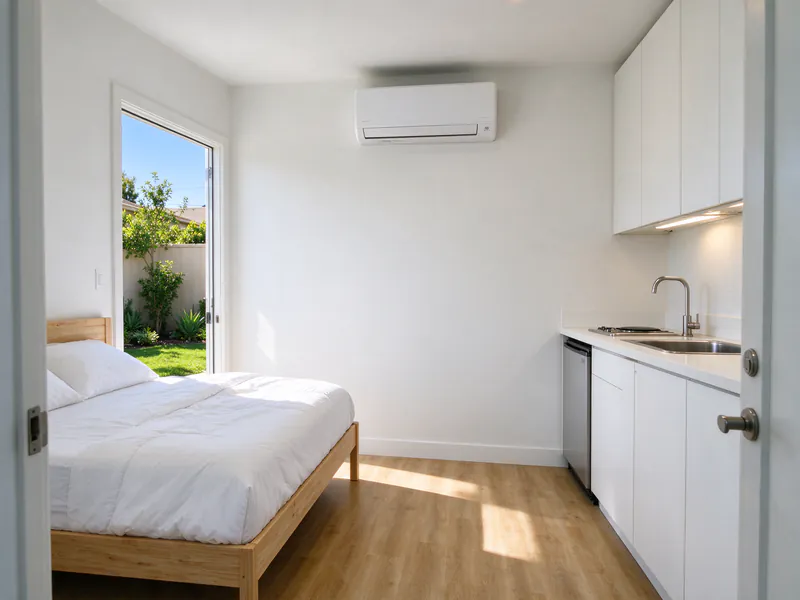
Mesa Mini Split San Diego installs mini splits in accessory dwelling units across San Diego and San Diego County: detached backyard cottages, attached units, garage conversions and junior ADUs. The work is done by licensed and insured contractors holding the California C-20 (HVAC) license, and it is planned around one fact that shapes everything else: an ADU is a separate dwelling, and its heating and cooling should belong to it.
ADUs are a steady part of San Diego building. The City’s development permit data counts about 2,100 ADUs on approvals issued in 2024 and about 2,000 in 2025, most of them on combination building permits. Each one is new or newly converted living space that needs heating and cooling of its own.
Why an ADU gets its own system
The plumbing of air explains it. The California Energy Commission’s ADU guidance notes that the California Mechanical Code does not allow return air from an existing forced-air system to be discharged into another dwelling unit. Tapping the main house’s ducts to serve the ADU would mix the two homes’ air, which the code is written to prevent.
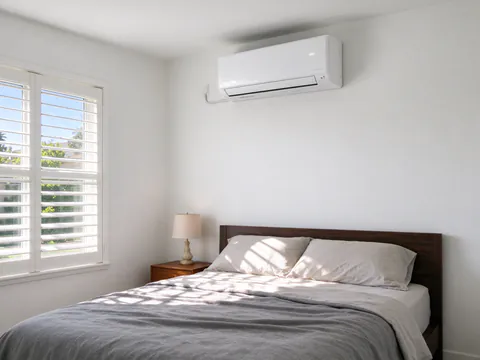
Control is the second reason. Whoever lives in the ADU, a family member, a caregiver or someone renting it, needs to set their own temperature without walking to the main house. A mini split gives the ADU its own remote or wall thermostat, and a heat pump model covers both cooling and heating. For most ADUs that is one outdoor unit and one or two indoor heads, a design closer to single-zone installation than to a whole-house system.
ADUs and JADUs are different projects
A detached ADU is a small house on its own foundation. An attached ADU shares a wall with the main home. A junior ADU, or JADU, is carved out of the existing house, such as a bedroom suite with its own entrance. The difference matters for permits, for Title 24 and for how the mini split is laid out.
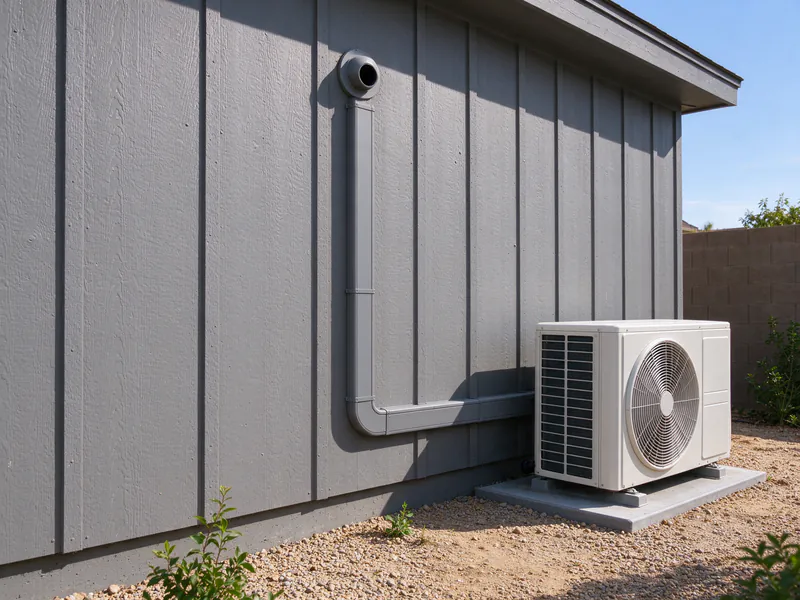
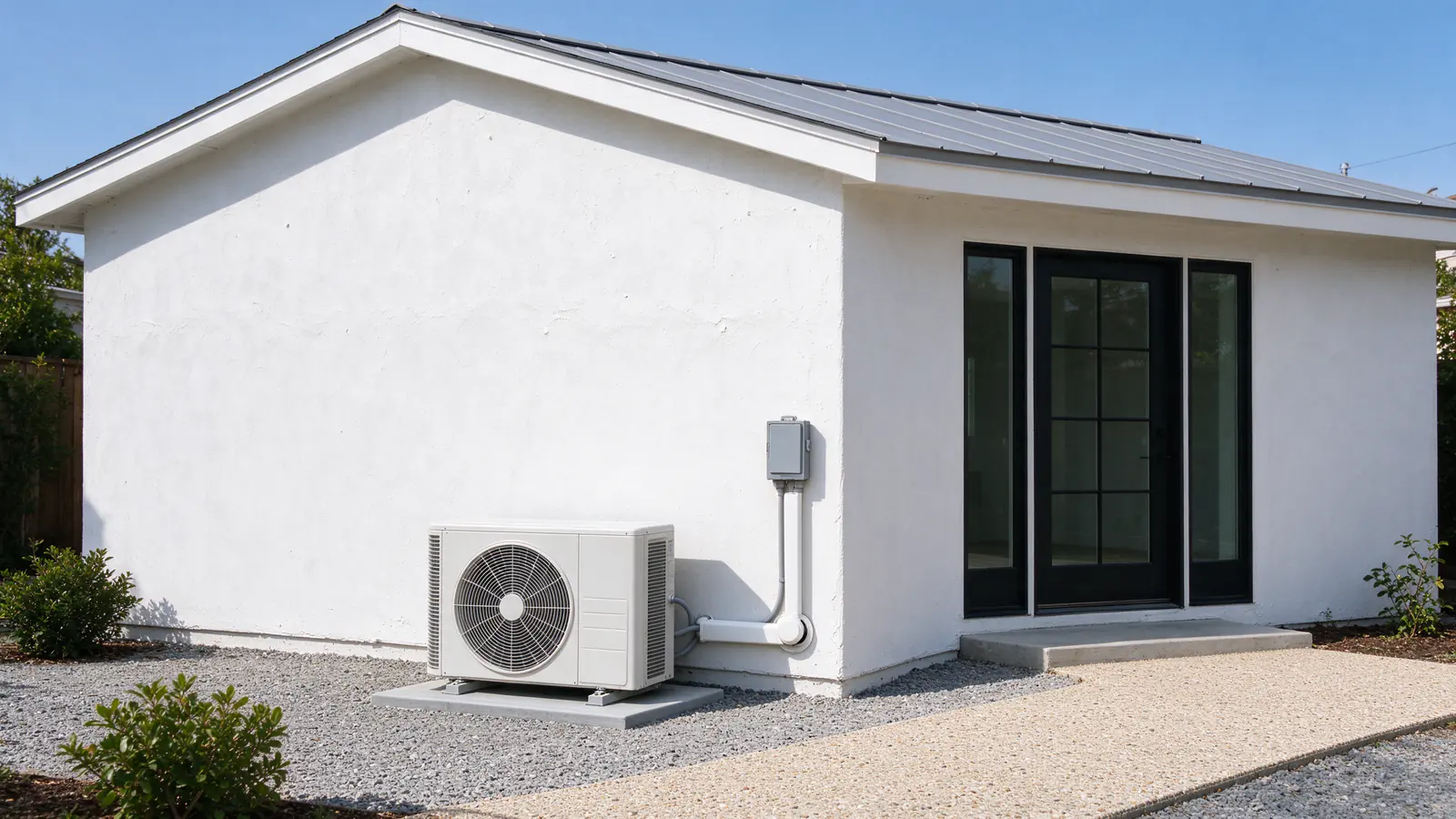
A JADU often needs only one head and a short line set through an exterior wall of the main house. Because it sits inside the existing building, its relationship to the main house’s air is part of the JADU’s own permit review, and a ductless head with its own control keeps the two systems apart without argument. A detached ADU needs its own outdoor unit placement, its own circuit and, often, an electrical feed run across the yard.
Title 24: new building or addition
The Energy Code treats ADUs differently by type. According to the CEC’s ADU guidance, a newly constructed detached ADU must comply with the Energy Code as a new building. Attached ADUs and conversions of unconditioned space, such as a garage, are treated as additions under section 150.2(a). The same guidance notes that mini splits and multi-splits may require field verification by an Energy Code Compliance (ECC) rater, the role many permit documents still call a HERS rater.
In practice the ADU’s energy compliance documents, prepared for its building permit, describe the heating and cooling equipment. The installed mini split has to match what those documents assume, or the documents have to be revised. For permits applied for on or after January 1, 2026, the 2025 Energy Code applies, and heat pump systems get refrigerant charge verification in every climate zone. Checking the equipment against the paperwork before ordering is cheaper than discovering a mismatch at final inspection. The permit guide covers the City’s process.
Sizing a small dwelling
Small, new and well insulated usually means a small load. That makes oversizing the main risk in a new ADU. A unit too large for a 450-square-foot cottage reaches the setpoint in minutes, shuts off and leaves the air damp, especially near the coast in late summer. The unit should have a low minimum output so it can run steadily on a mild day.
Conversions behave differently. A garage converted to an ADU may keep a slab floor, gain a large window where the door was, and face west. A Manual J calculation on the ADU’s own walls, windows, insulation and orientation sets the capacity. Location matters too: the CEC’s design data puts the 1% cooling design temperature at 82°F at Lindbergh Field but 88°F in Escondido and 90°F in El Cajon. The sizing guide explains the method.
One head or two
A studio or open one-bedroom ADU can often be served by one well-placed head. A bedroom with its door closed at night usually needs its own, which moves the design to a small multi-zone system or two single-zone systems.
Panel and service capacity
Adding an ADU adds a household’s worth of electrical load: cooking, water heating, laundry and the heat pump. The mini split’s circuit is usually the easy part. The real question is whether the main service can carry the whole ADU. Older San Diego homes with 100-amp service often need a load calculation and sometimes an upgrade. Where a 100-to-200-amp upgrade is needed, a typical San Diego-area range is about $2,800 to $5,500, before trenching, underground service or panel relocation. A detached ADU usually gets its own subpanel fed from the main house, and its cost depends on the distance and the trench. The electrical requirements guide explains the circuit side.
Garage conversions that become ADUs
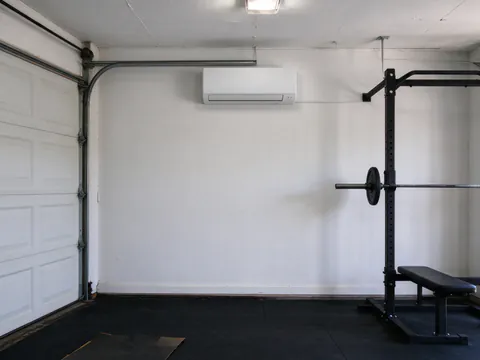
A garage converted into an ADU is a permitted change of use, with its own building permit, inspections and Energy Code compliance as an addition. The mini split is one part of that project. Installing a mini split in a garage, on its own, does not turn the garage into legal living space; conditioning a workshop or gym is a different project, covered on the garage installation page.
Coastal ADUs carry an extra permit step
In the City of San Diego’s Coastal Overlay Zone, many improvements to existing homes are exempt from a Coastal Development Permit. ADUs and JADUs are an exception: the Municipal Code makes them ineligible for that exemption when they are not completely contained in the existing primary structure, or when they add habitable area or convert nonhabitable space. A coastal ADU project therefore carries a coastal permit step that a mini split for an existing house does not, which affects when the HVAC rough-in can start. The coastal San Diego page covers other coastal conditions.
Placing the outdoor unit on a shared lot
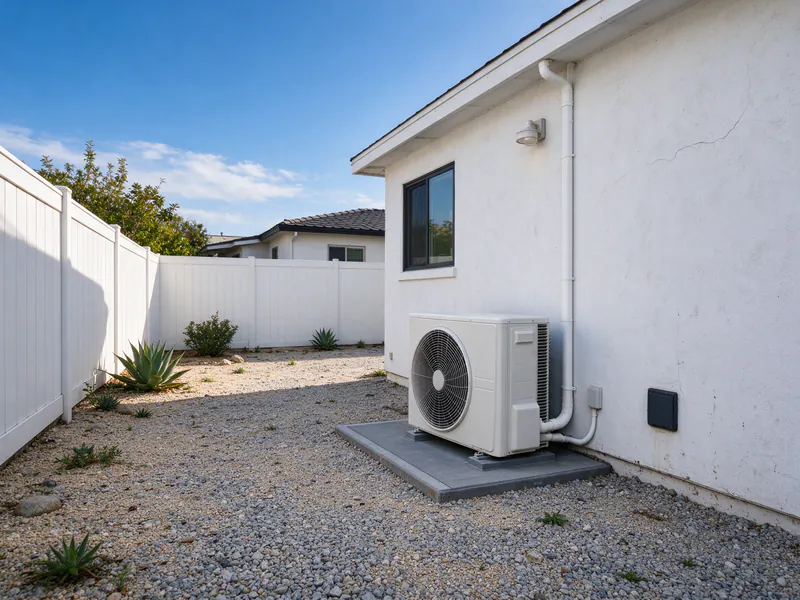
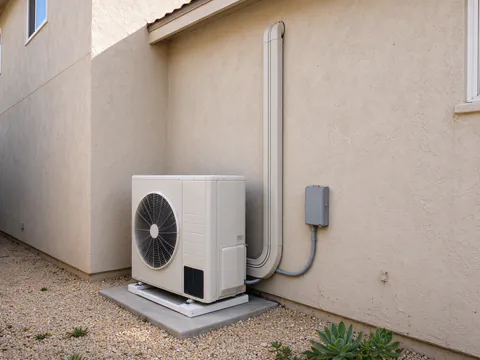
ADU lots get crowded: the main house, the ADU, a path between them and two sets of mechanical equipment. In the City’s residential zones, a condenser in a required side or rear yard sits at least 4 feet from the property line unless sound attenuation shows it meets the noise limits, which for single-family zones are 40 dB at night at the property line. From January 1, 2027, a state law, SB 222, limits the extra setbacks a city can impose on heat pump installations to 3 feet in side and back yards; how the City will apply it has not yet been published. The placement guide covers clearances.
Timing and cost
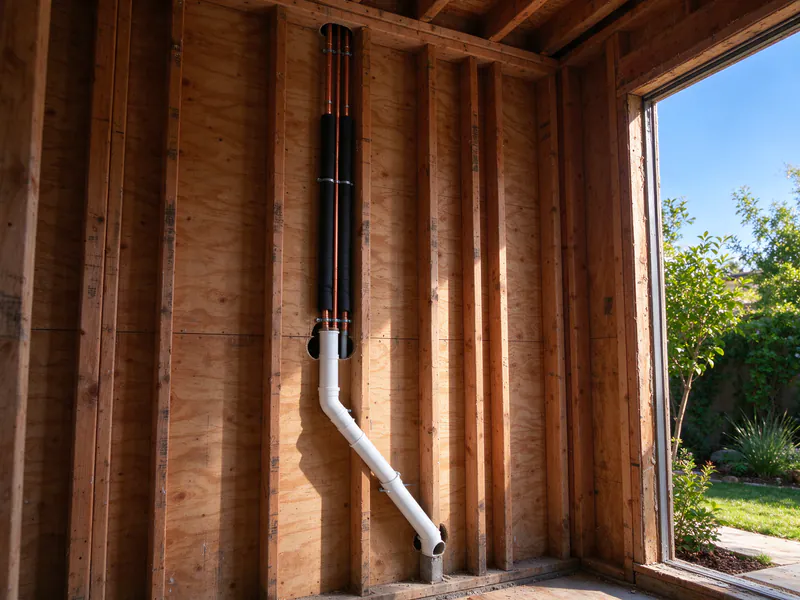
A mini split fits into an ADU build at two points. At rough-in, before insulation and drywall, the line set, control cable, drain and electrical run through open framing, which is cleaner and cheaper than routing them later. After paint, the heads, the outdoor unit and commissioning go in, ahead of the final inspection.
No separate ADU price range is published here. A single head and outdoor unit sits within the single-zone range, about $3,000 to $7,500 installed in the San Diego area; what moves an ADU job is the number of heads, the distance from the panel, any subpanel or service upgrade, trenching to a detached unit and the verification the compliance documents require. The installation cost guide and the cost estimator break it down further.