Mesa Mini Split San Diego repairs ductless mini splits across San Diego and San Diego County, including wall heads, ceiling cassettes, concealed duct units and multi-zone systems, whoever installed them. The work is carried out by licensed and insured contractors holding the California C-20 (HVAC) license.
Mini split repair is mostly diagnosis. The same symptom, a room that will not cool, can come from a dirty filter, a failed capacitor, a refrigerant leak or a sensor reading the wrong temperature, and those repairs differ by hundreds or thousands of dollars. Symptoms narrow the search; tests confirm the cause. Homeowners report getting conflicting diagnoses and replacement quotes when they asked for a repair, so the written finding should name the failed part and how it was confirmed before work starts. If the system has to come out, mini split replacement covers what can be reused.
When the system won’t cool or heat
Start with what is easy to rule out. The remote’s mode (Cool, not Fan or Dry), the setpoint, the filter, the breaker and whether the outdoor unit is running at all. A clogged filter alone can cut airflow enough to make a head feel weak.
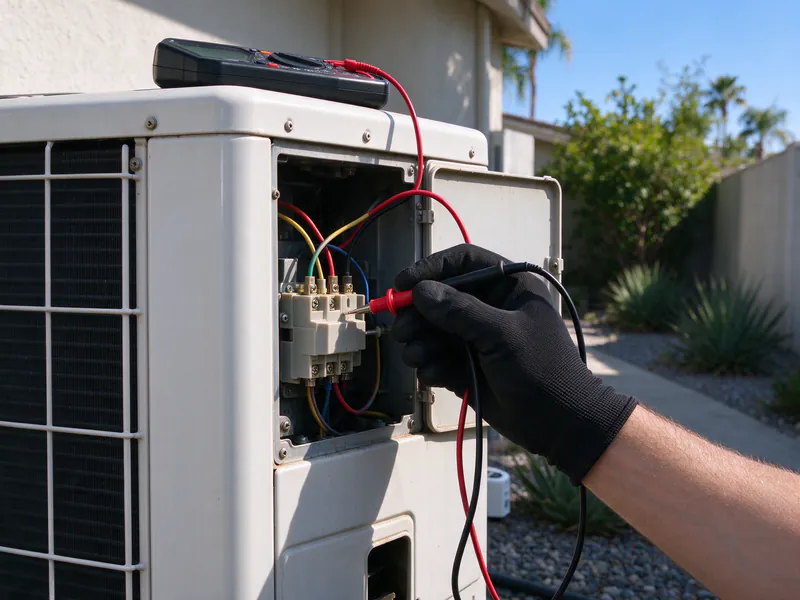
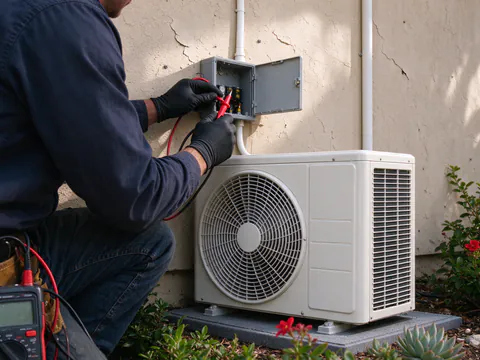
If the indoor fan runs but the outdoor unit does not, the usual suspects are electrical: a failed capacitor, a fan motor, the outdoor inverter board or a communication fault between the units. Replacing a capacitor typically runs about $150 to $500 for San Diego-area AC and heat pump repairs. An indoor blower or outdoor fan motor typically runs about $300 to $1,000. A control board typically runs about $400 to $1,200, with indoor-head boards at the lower end and the outdoor inverter board at the upper end.
If both units run but the air is barely cool, low refrigerant from a leak is a real possibility, though not the only one. A dirty indoor coil or blower wheel produces a similar symptom.
Refrigerant leaks
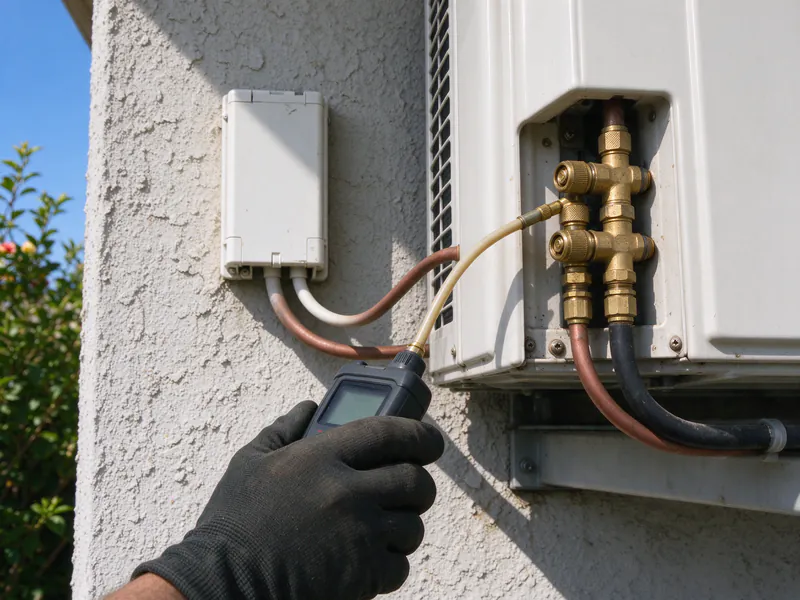
A mini split is a sealed system. If it is low on refrigerant, it has a leak, and recharging without fixing it buys time at best. The common spots are the flare connections at the indoor head and outdoor unit, where a poorly made flare can seep for years, followed by the coils and any line set damaged in a wall or under a line-hide. Near the coast, salt air corrodes outdoor coil fins and fittings faster than inland; the coastal versus inland guide explains the difference.
The repair sequence is the same as for a new install: find the leak with electronic detection or bubble solution, repair it, pressure-test with nitrogen, evacuate with a micron gauge and weigh in the charge to the manufacturer’s specification. Finding and fixing a leak and recharging typically starts around $300 and commonly runs to $1,500 or more for San Diego-area repairs; a leaking flare at the indoor head sits at the low end, a leaking coil or buried line set at the high end.
Water leaking from the indoor unit
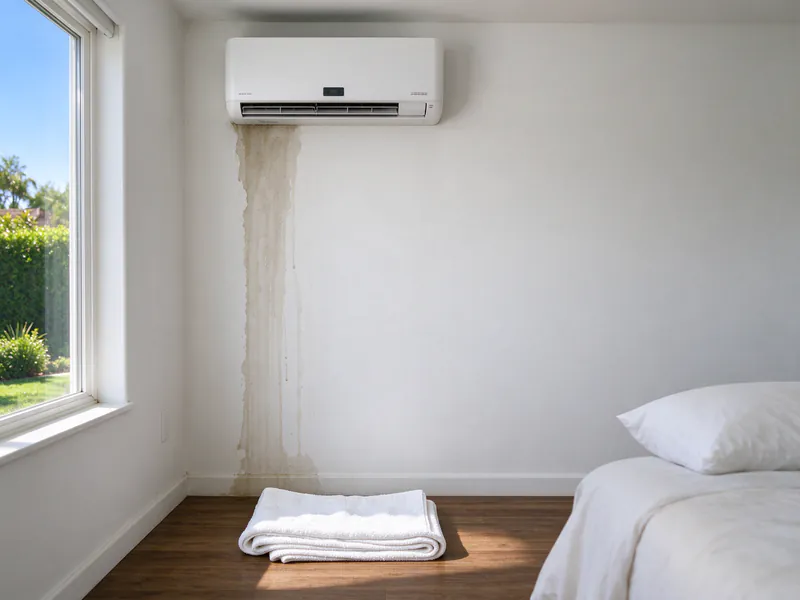
Water dripping down the wall or onto the floor below a head is the most common mini split complaint. The causes are mostly about the condensate path: a drain line clogged with slime or debris, a line that has lost its downward slope, a failed condensate pump, a head that has shifted out of level, or ice on the coil melting faster than the tray can drain. Late-summer coastal humidity raises the volume: NOAA’s normals put the August mean dew point at San Diego’s Lindbergh Field at 62.5°F, so heads produce steady water on muggy days and a partly blocked drain shows up quickly.
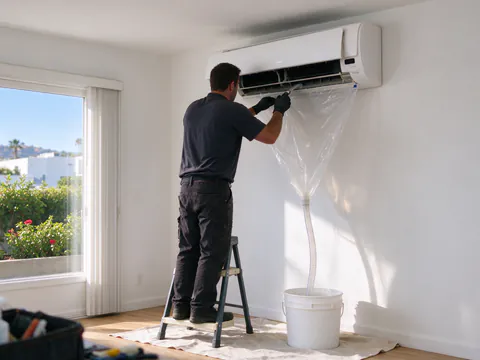
Clearing a clogged condensate drain line typically runs about $100 to $375 for San Diego-area service calls. Replacing a condensate pump typically runs about $220 to $500 installed. If the drain was never routed well in the first place, the condensate drainage guide explains what a reliable route looks like.
Error codes and blinking lights
Every manufacturer has its own code table, so a code means nothing without the model number. Codes generally point to a category: a temperature sensor out of range, lost communication between the indoor and outdoor units, a fan motor fault, high or low pressure, or an inverter fault. A code narrows the search, but a sensor code can come from the sensor, its wiring or the board reading it. Note the code or blink count and the model number from the label on the side of the indoor unit, and turn the system off at the breaker and back on once. If the code returns, that information makes the visit shorter.
Ice on the coil
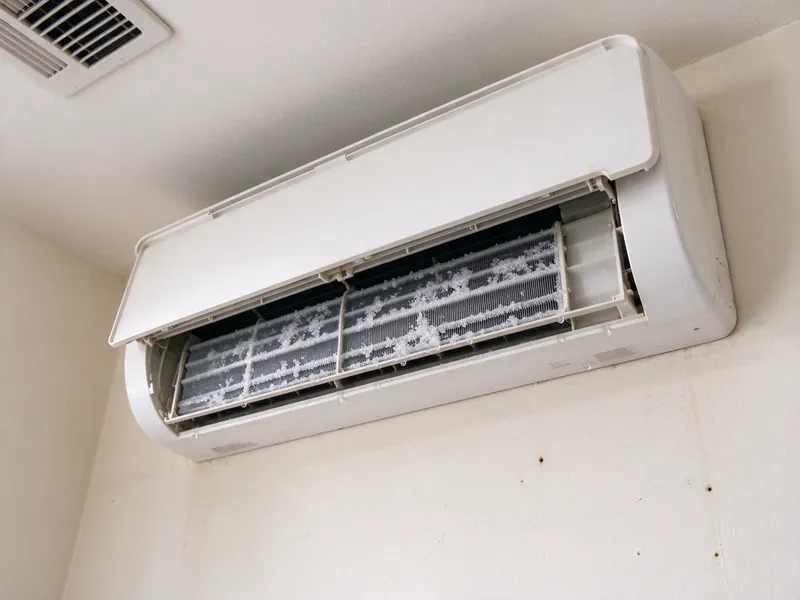
Ice on the indoor coil in cooling mode usually means the coil is running too cold. Restricted airflow, from a dirty filter or a blower wheel caked with dust and growth, is one cause; a low refrigerant charge is another; a faulty coil sensor can also confuse the system. Turn the system off or run Fan only to let the ice melt, with a towel under the head, and do not chip at it. Frost on the outdoor unit in heating mode is different: a short defrost cycle with steam is normal, and inland mornings in El Cajon or Escondido trigger it more than the coast.
Noise and short cycling
A new rattle or squeal usually has a mechanical cause: a blower wheel that is dirty or cracked and out of balance, a loose front panel, a line set touching a wall or bracket, or worn motor bearings. Outdoor units can also buzz when a capacitor or contactor is failing. The noise guide covers what normal operation sounds like.
Short cycling, where the system starts and stops every few minutes, is often a design problem rather than a broken part. An oversized head reaches the setpoint, shuts off and restarts without running long enough to dry the room, leaving it cool and clammy. On a multi-zone system, a small head calling alone can push the outdoor unit below its minimum output. Sensor faults and charge problems can do the same. The sizing guide explains why bigger is often worse.
The visit and what it costs
A diagnostic or service-call fee for San Diego-area HVAC repairs, mini splits included, typically runs about $75 to $150 for a standard daytime visit and up to about $250 for after-hours calls. Many companies credit it toward the repair if you go ahead. All figures on this page are budgeting ranges, not quotes. In the City of San Diego, the City’s permit guidance says repair-only work does not require a permit; replacing equipment does. For a system that cannot wait, emergency mini split repair is available 24/7.
When repair is not worth it
A compressor replacement typically starts around $1,400 and can pass $3,500 for San Diego-area systems, which is why age and warranty often tip that repair toward replacement. The reasoning goes like this: a younger system with a repair costing well under half of replacement is usually worth fixing; an older system with a failed compressor, repeated breakdowns or parts that are no longer available usually is not. A single-zone system typically runs about $3,000 to $7,500 installed, which is the comparison to keep in mind; the installation cost guide has the rest. Regular mini split maintenance catches drain and airflow problems before they become repairs, and commercial mini split installation covers offices and server rooms where downtime costs more.