
Install before the heat, because the steps that make a mini split work well take time. A site visit and load calculation, a written scope, a permit, the equipment, the installation and an inspection each have their own schedule, and in San Diego the uncomfortable stretches tend to come late in the warm season, when everyone else is calling too.
Mesa Mini Split San Diego installs mini splits across San Diego County, with the work done by licensed and insured contractors holding the California C-20 (HVAC) license and offers 24/7 emergency repair for systems that fail when it is hot. This post is about not needing the emergency.
Why the heat comes late here
The coast’s discomfort is as much moisture as temperature. NOAA’s hourly normals put Lindbergh Field’s mean dew point at about 61°F in July, 62.5°F in August and 61°F in September, the highest of the year, so the stickiest nights fall in late summer. Inland, NOAA’s normals count about 57 days a year at 90°F or hotter in El Cajon and about 54 in Escondido. Heat events add to that: in early September 2024, NOAA station records show Lindbergh reaching 94°F with a 75°F overnight low, El Cajon 108°F and Escondido 112°F. A house without cooling cannot shed heat overnight when the low stays in the mid-70s.
The steps that cannot be rushed
The installation process guide walks through each step. The ones that set the calendar are outside the installation itself:
- The site visit and load calculation. Capacity comes from a Manual J calculation for each room, not from square footage, and the sizing guide explains why that matters more inland.
- The panel. If an older 100-amp panel needs a load calculation or a service upgrade involving SDG&E, that work has its own sequence, covered in the electrical requirements guide.
- The permit. In the City of San Diego a mini split at a house is normally a no-plan permit, but historic designated properties need plans and historical review. The contractors pull the permit and coordinate the inspection as part of the work.
- HOA review. From January 1, 2027, Civil Code 4738 limits how an association can restrict a code-compliant cooling system in a member’s separate interest, but an HOA can still require a licensed contractor and repair of any common-area damage. The condo installation page covers it.
Start with one room if that is the budget
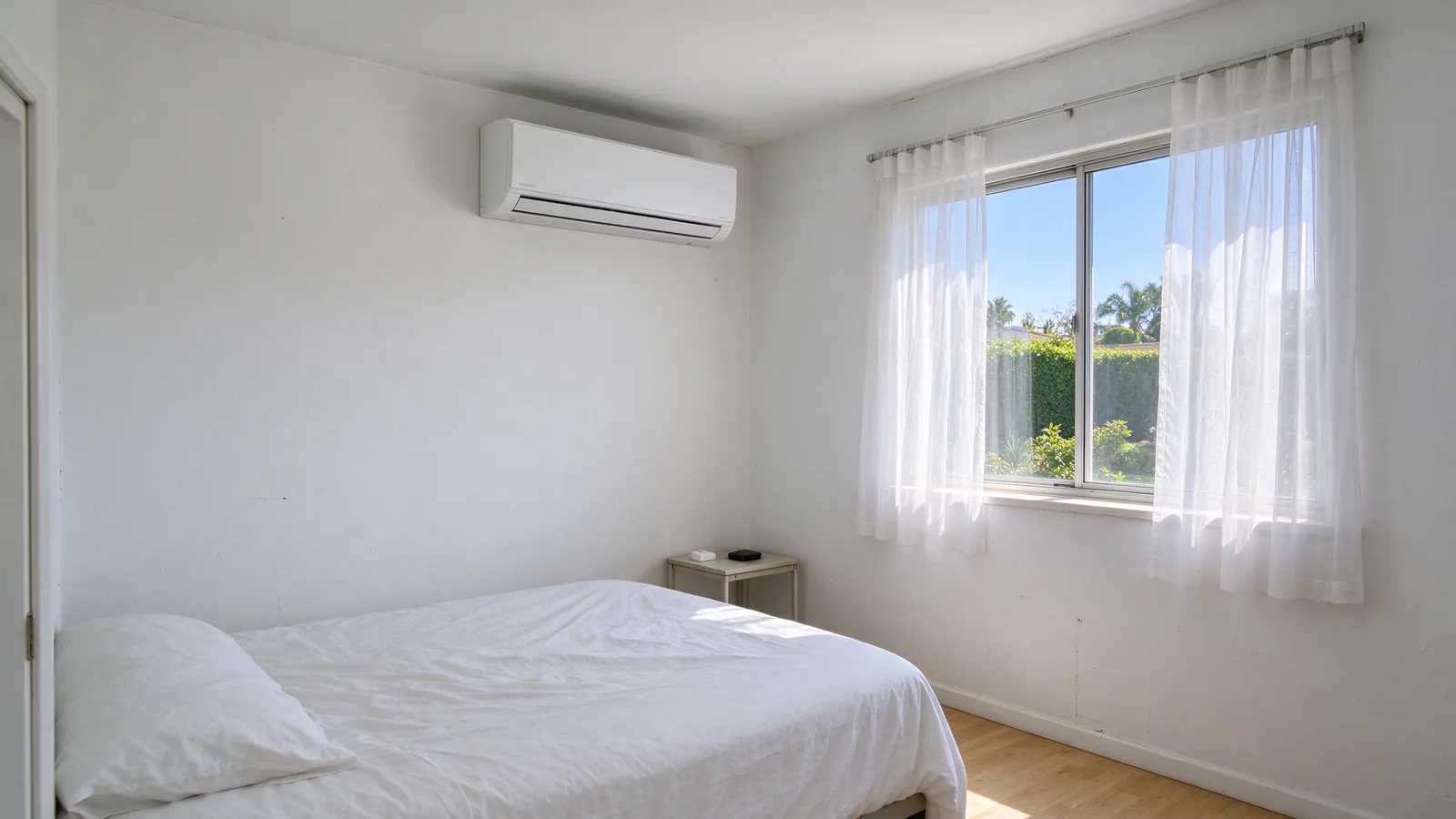
A whole-house plan does not have to happen at once. A single-zone system in the bedroom that never cools down at night is often the most useful first step. Choose the outdoor location and circuit with later rooms in mind, so a second head or a multi-zone upgrade does not mean redoing work.
Get an existing system ready
If a mini split is already on the wall, the cooler months are the time for maintenance: clean filters and coils, a clear drain and a technician’s look at fans, electrical connections and operating pressures. A unit that struggled last summer is a candidate for a repair visit before it fails on the hottest night.
Plan for the summer rate season
SDG&E’s summer prices are highest in the 4 to 9 p.m. on-peak window, and San Diego Community Power lists its summer season as June 1 through October 31. Cooling a room before 4 p.m. and coasting through the peak with a slightly higher setpoint keeps the bill down; the operating cost guide has the arithmetic.
For a planning figure now, the cost estimator gives a range without a phone call; then call or request an estimate to book the site visit while the weather is still mild.