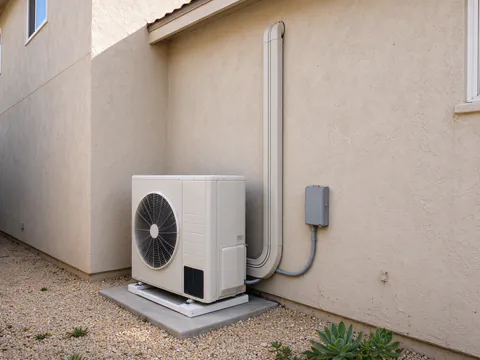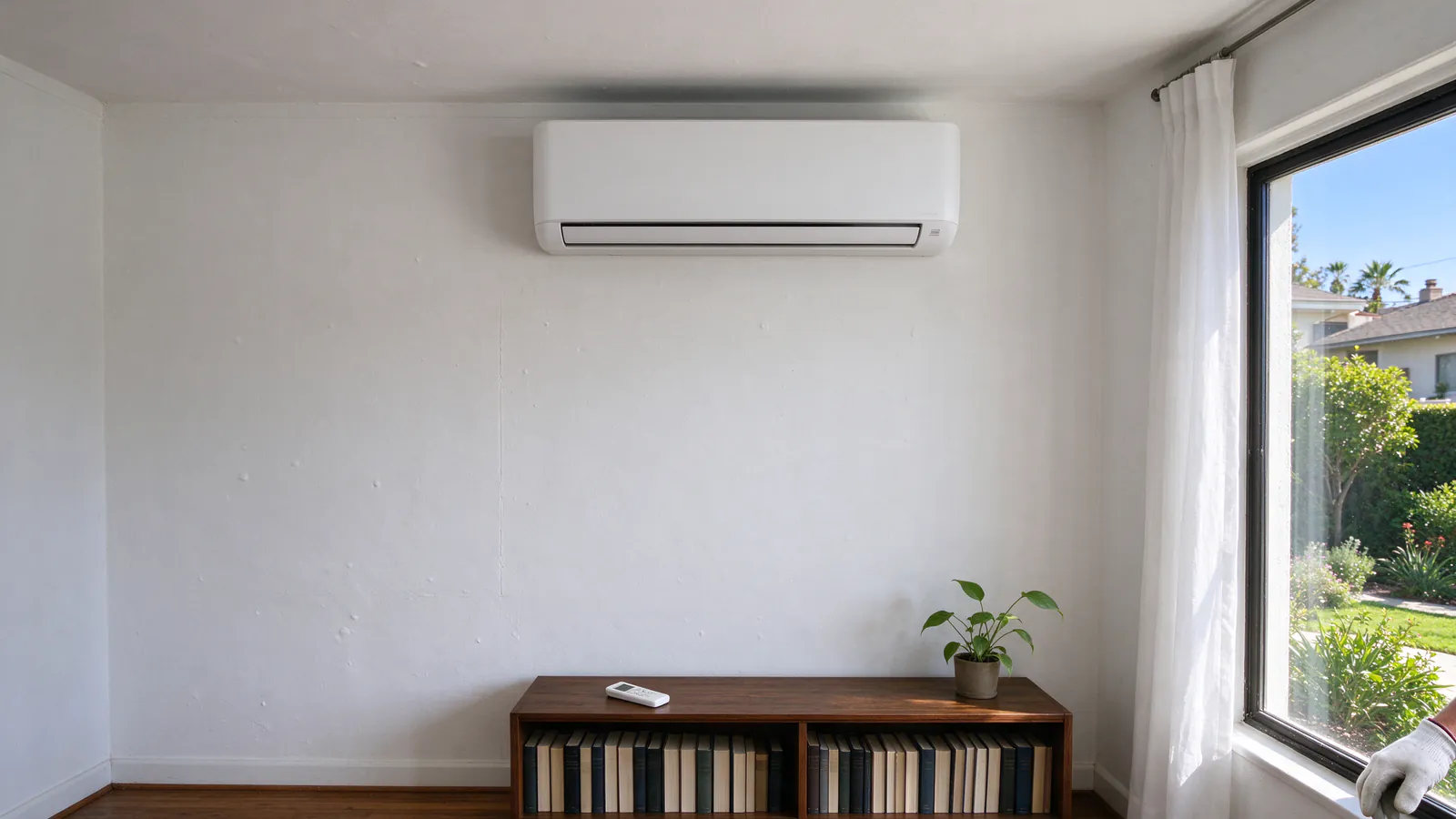
A mini split’s operating cost is the electricity it uses multiplied by the price of each kilowatt-hour at the hour it runs. In San Diego that price comes from SDG&E’s time-of-use schedules, roughly 34 cents per kWh at super off-peak on TOU-ELEC up to about 73 cents in the summer on-peak window, so when a system runs matters almost as much as how efficient it is.
Mesa Mini Split San Diego installs single-zone and multi-zone mini splits across San Diego County, with the work done by licensed and insured contractors holding the California C-20 (HVAC) license. This guide shows the arithmetic behind a running cost so you can test any estimate yourself. It does not predict a bill, because a bill depends on your house, your habits and rates that change from season to season.
What sets a mini split’s running cost
Four numbers set the cost, and only one of them is on the equipment’s spec sheet. The first is the load: how much heat has to leave the room in summer or enter it in winter. That depends on the room’s glass, insulation, orientation and occupants, and on where the house sits. The CEC’s design data puts the 1% cooling design temperature at 82°F at San Diego Lindbergh and 90°F at El Cajon, so the same bedroom asks for more cooling inland. The second is hours: an upstairs bedroom used every night in August runs far longer than a guest room. The third is efficiency, captured by the ratings explained below. The fourth is the price per kWh at the time the system is running.
Capacity is not on that list for a reason. A correctly sized inverter unit rarely runs at its rated capacity; it slows its compressor to match the load. Two units of different sizes serving the same room use similar energy if both modulate well. An oversized unit can use more, because it cycles on and off when the load falls below its minimum output, which wastes energy at each restart and leaves the air clammy.
SDG&E rates a mini split runs on
Most San Diego homes take electricity on one of two SDG&E time-of-use schedules. The figures below are SDG&E’s published total bundled rates, which change several times a year; use them for arithmetic, and check the current table before you rely on a result.
| Period | TOU-DR1 (standard) | TOU-ELEC (heat pump, EV or battery households) |
|---|---|---|
| Summer on-peak, 4 to 9 p.m. | about 69.1 | about 72.6 |
| Summer off-peak | about 46.4 | about 38.9 |
| Summer super off-peak | about 37.4 | about 34.5 |
| Winter on-peak, 4 to 9 p.m. | about 61.5 | about 50.6 |
| Winter off-peak | about 53.1 | about 37.7 |
| Winter super off-peak | about 43.7 | about 33.6 |
| Baseline credit | up to about 10.7 cents off, on usage up to 130% of baseline | none |
| Base services charge | about 79 cents a day | about 79 cents a day |
On weekdays, SDG&E’s super off-peak hours run from midnight to 6 a.m. and from 10 a.m. to 2 p.m.; on weekends and holidays, from midnight to 2 p.m. The on-peak window is 4 to 9 p.m. every day. San Diego Community Power lists its summer season as June 1 through October 31.
Which plan suits a heat pump household
SDG&E’s TOU-ELEC schedule is open to households with an electric heat pump for climate control, and a mini split heat pump qualifies. Its off-peak and super off-peak prices sit well below TOU-DR1’s, especially in winter, but it has no baseline credit, and its summer on-peak price is slightly higher. A household that uses little power overall, or cools mostly between 4 and 9 p.m., may come out ahead staying on TOU-DR1. A household that runs heads overnight and in the middle of the day, or also charges an EV, often does better on TOU-ELEC. SDG&E’s own rate comparison, run on your meter history, settles it.
Community power providers
In the City of San Diego, Chula Vista, Encinitas, Imperial Beach, La Mesa, National City and unincorporated areas, generation comes from San Diego Community Power by default; in Carlsbad, Del Mar, Escondido, Oceanside, San Marcos, Solana Beach and Vista, from Clean Energy Alliance. SDG&E delivers the power everywhere. The joint rate comparisons published by SDG&E and each provider show average totals within a few cents per kWh of SDG&E’s bundled price, so the arithmetic here holds within that margin. The Escondido and Oceanside pages note which provider serves each area.
Estimating kWh from capacity and runtime
A rough estimate follows one formula: energy used (watt-hours) equals heat moved (Btu) divided by efficiency (Btu per watt-hour). Seasonal ratings give an average efficiency, so the result is an average too.
Illustrative: a coastal bedroom head averages 6,000 Btu per hour of cooling for eight hours on a warm night, which is 48,000 Btu. At an illustrative seasonal efficiency of 20 Btu per watt-hour, that is 2,400 watt-hours, or 2.4 kWh. Spread across off-peak and super off-peak hours on TOU-ELEC’s summer prices, 2.4 kWh costs roughly 83 to 93 cents. The same energy used inside the 4 to 9 p.m. window would cost about $1.74. Thirty such nights add up to about $25 to $28 at the cheaper prices. These are illustrations of the method, not a forecast for any house.
Multiplying the rated capacity or the nameplate wattage by the hours of use overstates an inverter unit’s consumption, because the compressor spends most of its time well below full speed. The honest inputs are a load figure from a Manual J calculation and the hours you actually expect to run.
SEER2, HSPF2 and COP explained
SEER2 (seasonal energy efficiency ratio) is cooling delivered in Btu divided by electricity used in watt-hours over a standard test season. A higher SEER2 means fewer kWh for the same cooling. The “2” marks the current federal test procedure, which tests at more realistic airflow conditions and produces lower numbers than the older SEER for the same equipment, so compare SEER2 with SEER2. EER2 is the same ratio at a single hot test condition, closer to what an inland unit sees on a 90°F afternoon.
HSPF2 (heating seasonal performance factor) does the same for heating: Btu of heat delivered per watt-hour across a heating season. Dividing HSPF2 by 3.412 converts it to an approximate seasonal COP, the coefficient of performance, which is heat out divided by electricity in, in the same units. A COP of 3 means three units of heat for each unit of electricity. Electric resistance heat, such as a wall heater or baseboard, has a COP of 1. COP falls as the outdoor air gets colder, so a heat pump is most efficient on mild nights, which describes most San Diego winter nights; the published low-temperature figures for the specific model matter more in inland zones.
Heating with a mini split vs a gas furnace
Cooling has no cheaper alternative on the bill, but heating does. An estimate from SDG&E’s published rates, using an average residential gas price of about $2.65 a therm in a recent month, puts the cost of delivered gas heat at about $3.31 per therm-equivalent with an 80% furnace. A heat pump at COP 3 costs about $3.68 for the same heat at TOU-ELEC winter off-peak prices and about $3.29 at super off-peak. The break-even COP against that furnace is roughly 3.3 at TOU-ELEC winter off-peak, about 3.0 at super off-peak and about 4.7 at TOU-DR1 winter off-peak.
In plain terms, a heat pump replacing gas heat may cost about the same or more to run, depending on the rate plan and the model’s real-world COP. The amounts are also small: the CEC’s residential appliance survey found SDG&E gas-heated homes used about 100 therms a year for space heating, roughly $265 a year at that gas price, by estimate. Replacing electric resistance heat is different. At COP 1, resistance heat costs about three times as much per unit of heat as a COP 3 heat pump, which is where heating savings are realistic. No savings are guaranteed either way. Most San Diego households choose a mini split for cooling and comfort, and the rebates guide covers what support remains.
Practical ways to keep the running cost down
- Cool before 4 p.m. on hot days and raise the setpoint a few degrees during the on-peak window, rather than letting the house heat up and fighting it at 6 p.m.
- Close doors to rooms a head does not serve, so it conditions the space it was sized for; one head rarely conditions a whole floor evenly.
- Clean the indoor filters as the manual directs; a clogged filter and dirty coil lower airflow and efficiency. Maintenance covers coil and blower cleaning.
- On a multi-zone system, avoid oversizing the outdoor unit for the rooms most often used alone; the single-zone vs multi-zone guide explains why.
- Compare running costs with the mini split vs window unit and mini split vs central air guides if you are weighing systems.
Putting a running cost next to the installed price
A running cost estimate is most useful beside an installed price, because the two trade against each other: a higher-efficiency model costs more up front and saves kWh every hour it runs. The installation cost guide and the cost estimator cover the purchase side. For a figure tied to your rooms, a site visit with a load calculation gives the load and capacity numbers this arithmetic needs; call or request an estimate to book one.