
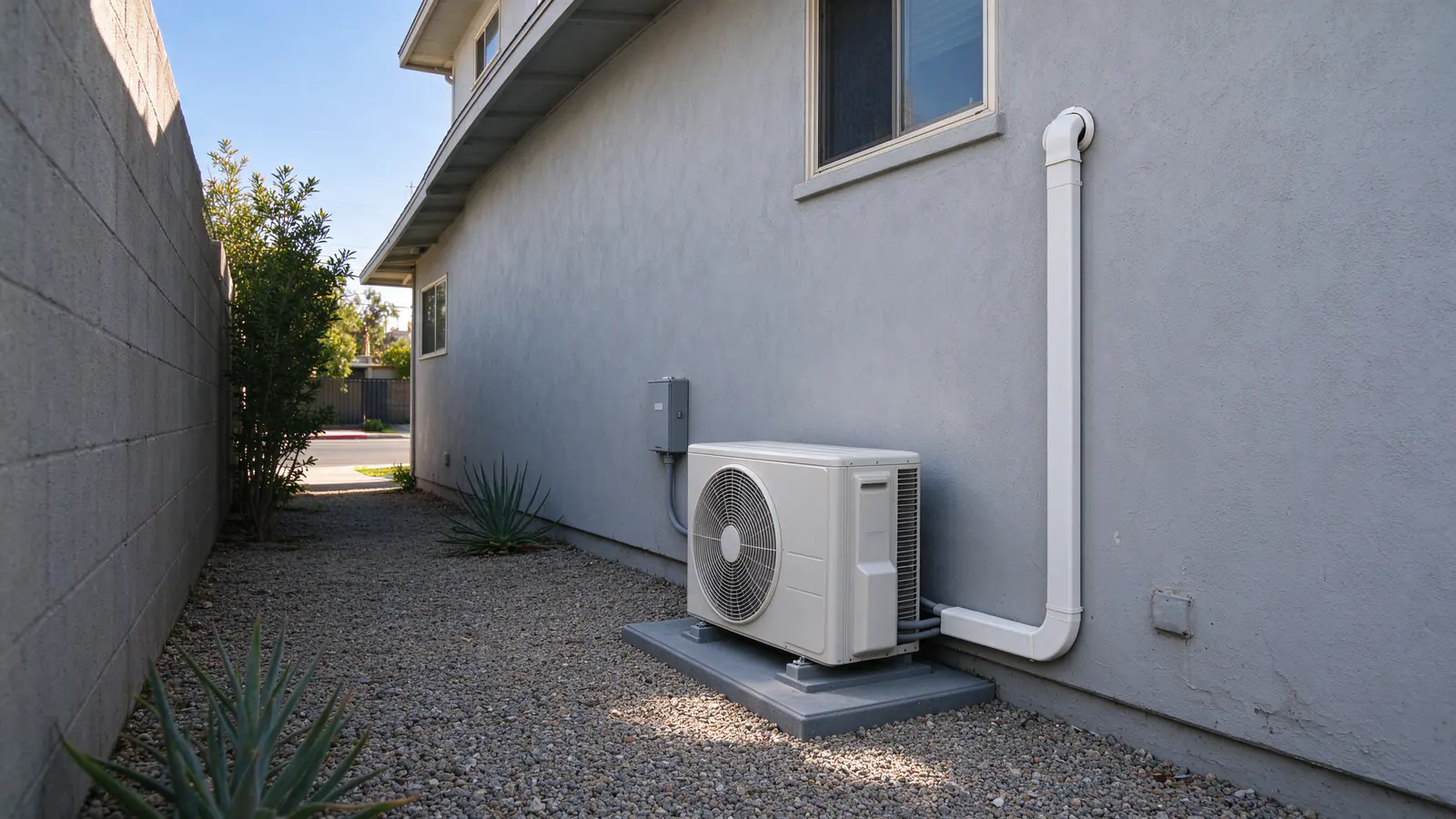
A typical mini split installation runs through a first call, a site visit with a load calculation, a written scope, a permit, the installation and testing, an inspection and a walkthrough. This post follows one invented project through each stage.
Mesa Mini Split San Diego installs mini splits across San Diego County, with the work done by licensed and insured contractors holding the California C-20 (HVAC) license. The installation process guide explains each step in technical detail; this walkthrough shows how they fit together on one house.
The house and the problem
Imagine a two-story stucco house from the 1960s in an inland part of the City of San Diego, with a wall furnace downstairs and no ducts. The upstairs main bedroom faces west, has two windows and sits under the roof. On summer evenings it stays well above the rest of the house, and the owners sleep downstairs during heat spells. They want that one room fixed.
The first call and the site visit
On the first call the owners describe the room and the house. At the site visit the room is measured, including its windows and their orientation, and the attic insulation is checked. A Manual J load calculation sets the head’s capacity. The visit also looks at the panel (a 100-amp service, in this example, with two open spaces) and walks the outside of the house to find a spot for the outdoor unit.
The side yard below the bedroom is narrow. The outdoor unit goes on the opposite side, where the yard is wider and the unit can sit more than 4 feet from the property line, as the City requires for at-grade units in required side yards without sound attenuation. That adds line-set length, so the route is measured against the model’s published limits. The placement guide explains the trade-off.
The written scope
The scope names the indoor and outdoor model numbers, the head location above the bedroom door, the line-set route through the exterior wall and down a painted line-hide, a gravity condensate drain running inside the line-hide to a splash block, a new dedicated 240V circuit with a disconnect beside the outdoor unit, the City permit and the commissioning steps. A single-zone job of this kind falls within the typical San Diego-area range of about $3,000 to $7,500; the installation cost guide explains what moves a job within it.
The permit
The house is not historically designated, so in the City this is a no-plan combination permit covering the mechanical and electrical work, starting from $176.57 for the first mini-split unit. The contractors pull it and coordinate the inspection.
Installation day
The head’s mounting plate goes up first, level and anchored to framing. A core drill makes one penetration through the stucco, angled slightly to the outside. The line set, communication cable and drain pass through it, the opening is sealed, and the stucco is patched. Outside, the outdoor unit is set level on a pad with rubber isolation feet, the line-hide goes up the wall, and the new circuit runs from the panel to the disconnect. The electrical requirements guide covers the circuit.
Testing and commissioning
The flare connections are tightened to the specified torque. The line set and indoor coil are pressurized with dry nitrogen and held to confirm they are tight, then evacuated with a vacuum pump until a micron gauge shows a deep vacuum that holds. Refrigerant is released and the charge set to the manufacturer’s specifications, with extra added by weight for the longer run. The system runs in cooling and heating, and water poured into the drain pan runs out at the splash block, as the condensate drainage guide describes.
Inspection and walkthrough
The City inspector checks the work against the permit, and any field verification on the compliance form is completed. At the walkthrough the owners learn the remote, the quiet mode, how to clean the filters and why cooling before 4 p.m. matters on SDG&E’s time-of-use rates.
If your project looks like this one, or nothing like it, the cost estimator gives a planning range, and a call or estimate request books the site visit for your own house.