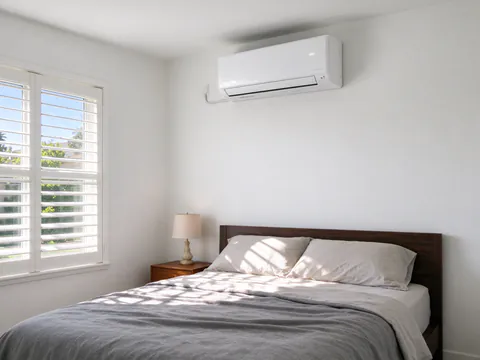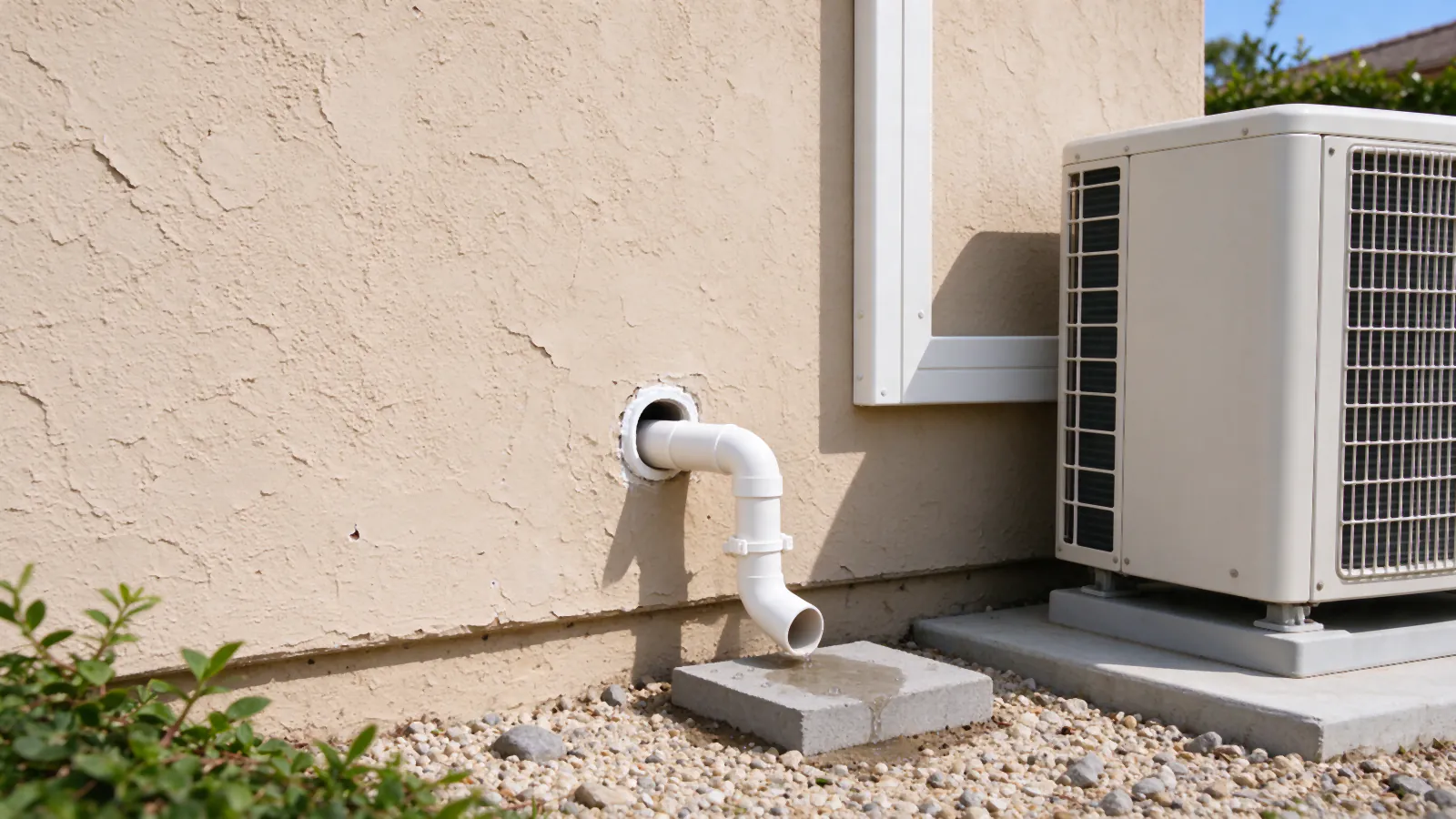
A mini split condensate drain line carries the water that forms on the indoor coil during cooling from the unit’s drain pan to a safe place outside or to an approved drain. Where the line can fall continuously downhill, gravity does the work; where it cannot, a small condensate pump lifts the water first. Most indoor leaks trace back to this path.
Mesa Mini Split San Diego installs mini splits across San Diego County and plans the condensate route for every indoor head as part of the design, with the work done by licensed and insured contractors holding the California C-20 (HVAC) license. This guide explains how drains work, when a pump is needed, what goes wrong and what a leak can and cannot tell you.
Where the water comes from
When the indoor coil runs below the dew point of the room air, water vapor condenses on its fins, the same way a cold glass sweats. The water runs into a drain pan under the coil and from there into the drain line. This is the dehumidifying half of air conditioning, and it is why a mini split makes a sticky room feel better even before the temperature drops much.
Coastal San Diego produces more of this water than its mild temperatures suggest. NOAA’s hourly normals put the August mean dew point at Lindbergh Field at about 62.5°F, and early-morning relative humidity, derived from those normals, runs around 80% from June through September. The CEC’s design data pairs Lindbergh’s 82°F cooling design temperature with a 69°F wet bulb, about the same moisture as El Cajon’s at 90°F. Near the coast, more of each hour’s cooling load is moisture, a point the coastal vs inland guide and the coastal San Diego page both take up. Inverter units that run long, gentle cycles remove that moisture steadily, which is good for comfort and means the drain carries water for hours at a time.
Gravity drains
A gravity drain is the simplest and most reliable path: a pipe or hose that leaves the drain pan and falls continuously to its outlet. On a wall head mounted on an exterior wall, the drain usually leaves through the same penetration as the line set, below the refrigerant lines, and runs down inside the line-hide to its outlet near grade.
The details that matter are dull and decisive. The line has to slope downhill along its whole length, at the pitch the manufacturer’s instructions call for, with no sag where water can sit. The head itself has to be level, or tilted slightly toward the drain side as the manual specifies, or water collects at the wrong end of the pan. Inside walls, a drain line can sweat on humid days, so it is insulated where condensation on it could damage finishes.
Traps
Whether a trap belongs on the drain line follows the manufacturer’s instructions for that indoor unit. Some air handlers, particularly ducted ones, call for a trap to stop air being drawn up the drain; on units that are not designed for one, a trap can hold water and sludge and slow drainage. The installer follows the manual for the specific model rather than a rule of thumb.
Condensate pumps
A pump is needed where the water cannot fall to an outlet: a head on an interior wall, a ceiling cassette, a concealed duct unit in an attic, or a room below grade. Small pumps fit inside the line-hide, behind the head or in the ceiling cavity; many cassettes have a lift pump built in. The pump collects water in a small reservoir and, when a float or sensor detects that it is full, pushes it up and out to a line that can then drain by gravity.
A pump adds three things a gravity drain does not have. It needs power. It makes a little noise when it runs, which the noise guide covers. And it can fail: the float sticks, slime clogs the inlet, or the motor wears out. Many pumps include a high-level safety switch that stops cooling when the reservoir overflows, which turns a potential leak into a unit that stops cooling. A pump is reliable when it is chosen for the lift and flow it faces and cleaned during maintenance, but it is a moving part, and the condensate path is worth discussing on every installation route.
Where the water can go in San Diego
The drain has to end somewhere that does not cause a new problem. Good practice keeps the outlet away from the foundation so water does not pond against the house, off walkways where a constant drip leaves stains and algae, and away from a neighbor’s property. On narrow side yards that can take some planning. Where an outside outlet is not practical, an indoor connection to plumbing may be considered, but how and where the line may discharge is governed by the plumbing and mechanical codes, so the route is confirmed per address and checked at inspection. In the City of San Diego the condensate work falls under the same no-plan permit as the rest of the installation; the permits guide covers it.
Drain blockages
Drain lines block slowly. The drain pan is dark, damp and fed with whatever dust slips past the filter, so a film of biological growth builds up and eventually sheds into the line. Insects can nest in an open outlet. A line can be kinked or crushed behind the head during installation, then slow to a trickle months later when the cooling season peaks. The first sign is often water at the bottom of the head on the most humid day of the year.
Indoor unit water leaks: what they can mean
Water where it should not be is a symptom, and several causes produce the same drip. Treat these as possibilities to check, not a diagnosis.
| What you see | Possible causes |
|---|---|
| Water dripping from the bottom of a wall head while cooling | Blocked drain line or pan, a sag in the line, head not level, failed pump |
| Water on the wall below the head, outside the unit | Uninsulated or poorly sealed line set or drain sweating inside the wall, a leaking drain connection |
| Drips only on very humid days | A drain or pump at the edge of its capacity, partial blockage, slope too flat |
| Water after the unit has been running with frost or ice on the coil | Very dirty filters, low airflow or a refrigerant problem, then meltwater overwhelming the pan |
| A cassette or ducted unit that has stopped cooling, with no visible leak | A condensate safety switch tripped by a full pump reservoir |
If a head is dripping, switch it off, protect the floor and furniture, and leave the cover closed. A leak that is soaking a wall or ceiling, or a server room or business space that cannot go without cooling, is a case for emergency mini split repair, which is available 24/7. Otherwise, book a mini split repair visit; the diagnosis checks the drain, the pump, the slope and the coil before anything is replaced.
Planning the drain on a new installation
A clear quote names the condensate route for each head: gravity or pump, where the line runs and where it ends. On a multi-head job, each head can need a different answer, which is one reason the indoor unit types guide compares drainage by type. Call or request an estimate, and the site visit will trace each drain path before the head locations are final.