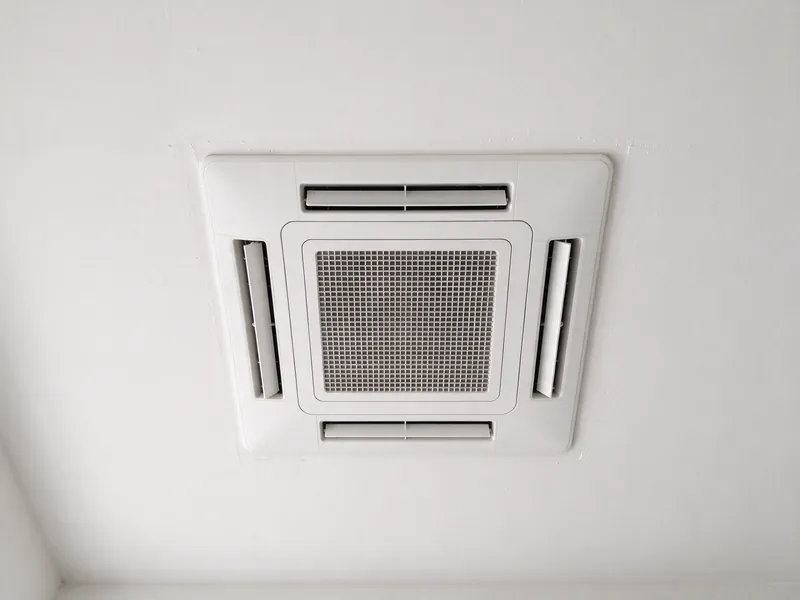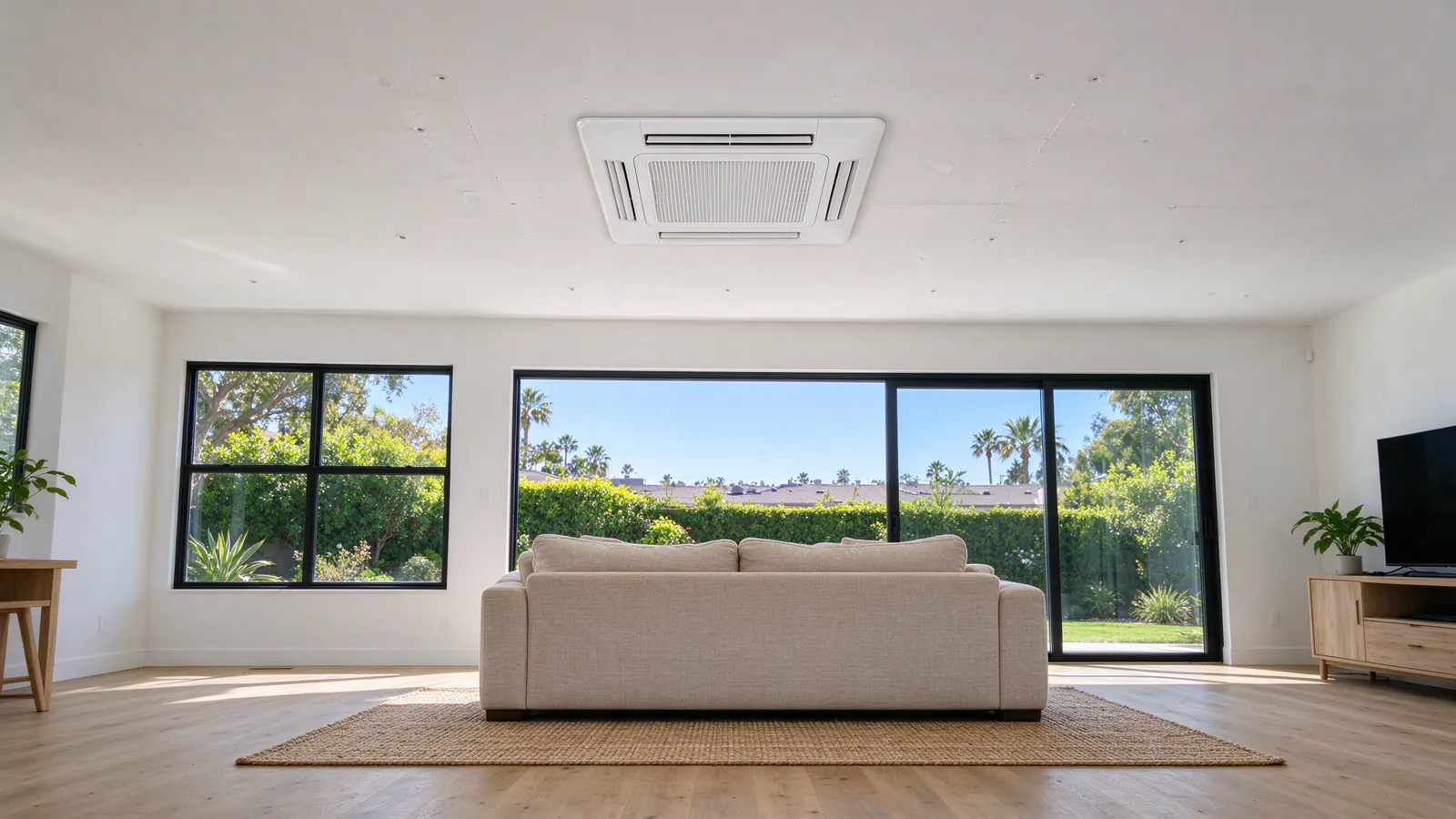
Mesa Mini Split San Diego installs ceiling cassette mini splits across San Diego and San Diego County, in homes and in light commercial spaces. The work is done by licensed and insured contractors holding the California C-20 (HVAC) license. A cassette is the indoor head that sits flush in the ceiling instead of on a wall: a square grille, usually in the middle of the room, that throws conditioned air out in up to four directions.
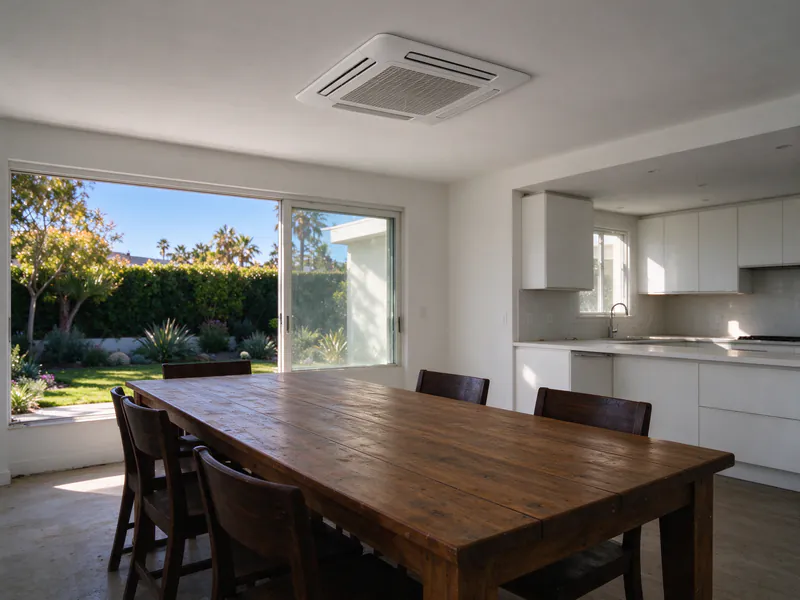
The appeal is obvious in a living room with a wall of windows, a kitchen with cabinets on every wall, or a room where a wall head would sit right over the artwork. The tradeoff is that the work moves into the ceiling and the attic above it. Framing, attic depth, the drain and future service access all have to work before a cassette is the right choice, and that is what the first visit checks.
Above the ceiling: joists, framing and attic depth
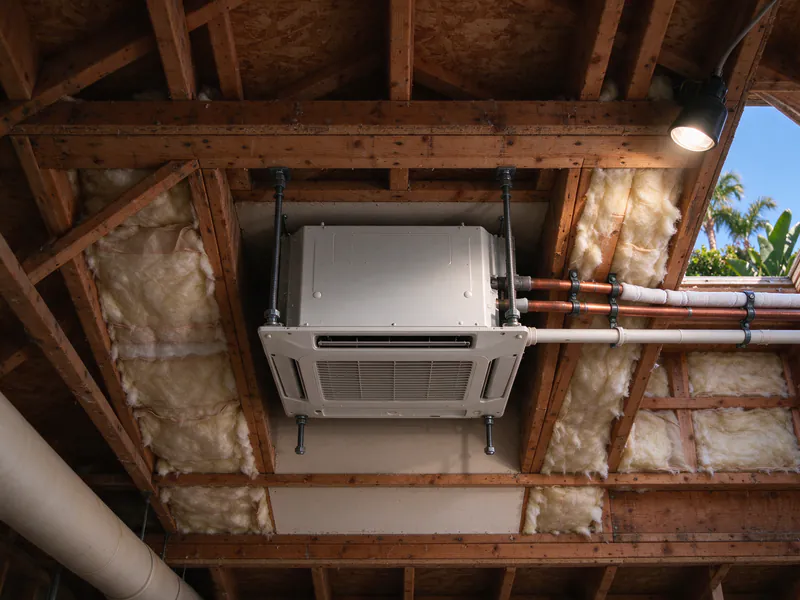
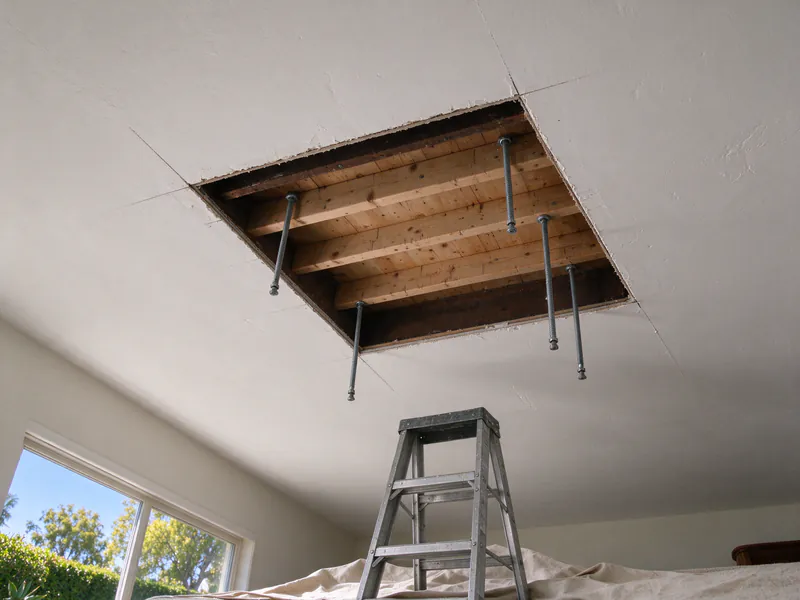
A cassette hangs from the ceiling structure on threaded rods and needs an opening cut between framing members. Its body is wider than the gap between many joists, so the first question is where the joists run and how far apart they are. Where the opening fits between two joists, the job is simpler. Where a joist sits in the way, the cassette either shifts slightly, which usually still gives good air distribution, or the joist is headed off: cut and carried around the opening by new framing. In the City of San Diego, altering supporting structure for equipment requires construction plans and a building permit under Development Services’ Information Bulletin 103, so a framing change is settled before the quote rather than discovered on install day.
Depth matters as much as width. The installation manual lists the minimum height the cassette needs above the ceiling, and attic spaces get shallower toward the eaves. A cassette that fits in the middle of the room may not fit near an exterior wall. Some manufacturers make slimmer bodies for shallow spaces, and some compact models are designed to drop into a 2-by-2-foot suspended ceiling grid in commercial spaces. The model is chosen after the attic is measured, not before.
Single-story houses and attic access
Where a single-story San Diego house has an attic over the main rooms, reached through a hatch in a hallway or closet, a cassette is often practical: lines, control cable and drain run through the attic to an exterior wall, and the cassette body sits above the room it serves. Where a house has a low-slope roof with little or no attic, or a vaulted ceiling with rafters exposed inside, a cassette may not fit at all, and a wall head or a concealed duct unit in a nearby space becomes the comparison.
The attic itself is hot in summer, and more so inland. The California Energy Commission’s design data puts the 1% cooling design temperature at 82°F at Lindbergh Field and 90°F in El Cajon, and an attic over a sunny roof runs well above outdoor air. Line sets crossing it need continuous insulation so they do not pick up heat or sweat, and drain lines need support so they keep their slope. On two-story houses, a cassette on the upper floor uses the attic; one on the ground floor sits in the floor framing between stories, which is harder to reach and more often ruled out.
The drain: built-in pump, then a sloped line
Every head makes water in cooling, and a cassette’s drain pan sits at the lowest point in the ceiling. Most cassettes include a built-in condensate pump that lifts water up into the attic, because the line usually has to rise before it can fall to an outside outlet. The installation manual sets how high the pump can lift and how far the line can run after the lift. From that high point, the line needs continuous downward slope, supported so it does not sag and hold water.
A gravity drain, where the attic allows it, removes the reliance on the pump. Either way, the outlet outside is placed where water will not stain stucco, pool against the foundation or drip on a path. A pump that fails stops draining. Many cassettes carry a float switch meant to stop the unit before the pan overflows, but whether one is fitted, and whether it works, is something to confirm, and the check is part of every maintenance visit. The condensate drainage guide explains both methods.
Four-way air throw and where the cassette goes
A cassette’s louvers send air out from each of its four sides, which suits square rooms, open-plan spaces and rooms where the furniture sits away from the walls. Many models let each louver be set separately, so a side facing a wall or a seating area can be closed down or angled to avoid drafts; what each model allows is in its manual. Placement is a balance: centered in the room for even throw, but not directly over a bed or sofa where people feel the airflow, and placed where the framing and attic depth allow.
Service access is part of placement. Filters come out through the front grille, so a cassette over a stairwell or a high vaulted section is harder to look after. The pump, drain connection and sometimes the control board are reached through the grille as well. A cassette is a fixed part of the ceiling for years, so it goes where someone on a stepladder can reach it.
One cassette, or cassettes in a multi-zone system
A single cassette on its own outdoor unit is a single-zone system, sized for the one room it serves. Cassettes can also share a multi-zone outdoor unit with other heads, as long as the manufacturer lists them as compatible. A common pattern is a cassette in the main living area and wall heads in the bedrooms, because the smallest cassette in a range may still be too large for a small bedroom. A head that is too big for its room cycles on and off and leaves humidity behind, which matters in coastal homes on muggy late-summer days. The sizing guide explains how room loads are built, and the indoor unit types guide compares cassettes with wall, floor and ducted heads.
Permits and what moves the price
At a house or duplex in the City of San Diego, a cassette installation falls under the same no-plan combination permit as other mini splits, with the fee starting from $176.57 for the first mini-split air handler and the exact total set when the permit is issued. If the ceiling framing must be altered to carry the unit, plans and a building permit apply. The permit and inspection are part of the work. In nonresidential buildings, the City requires plans and plan review for a new installation; commercial mini split installation covers that path.
A cassette costs more than a wall head serving the same room, and there is no reliable public figure for the difference, so it is priced from what moves it: the cassette itself, attic access and working space, framing or blocking, the ceiling cut and any drywall patch and paint, the pump and the drain route, line-set length through the attic, and whether the cassette joins a multi-zone system. For overall budgets, the installation cost guide and the cost estimator give typical San Diego-area ranges by number of heads; the cassette drivers above are what move a job within those ranges.