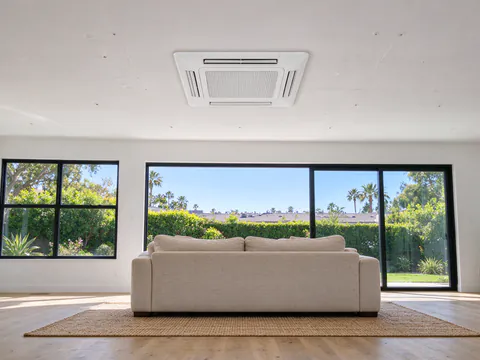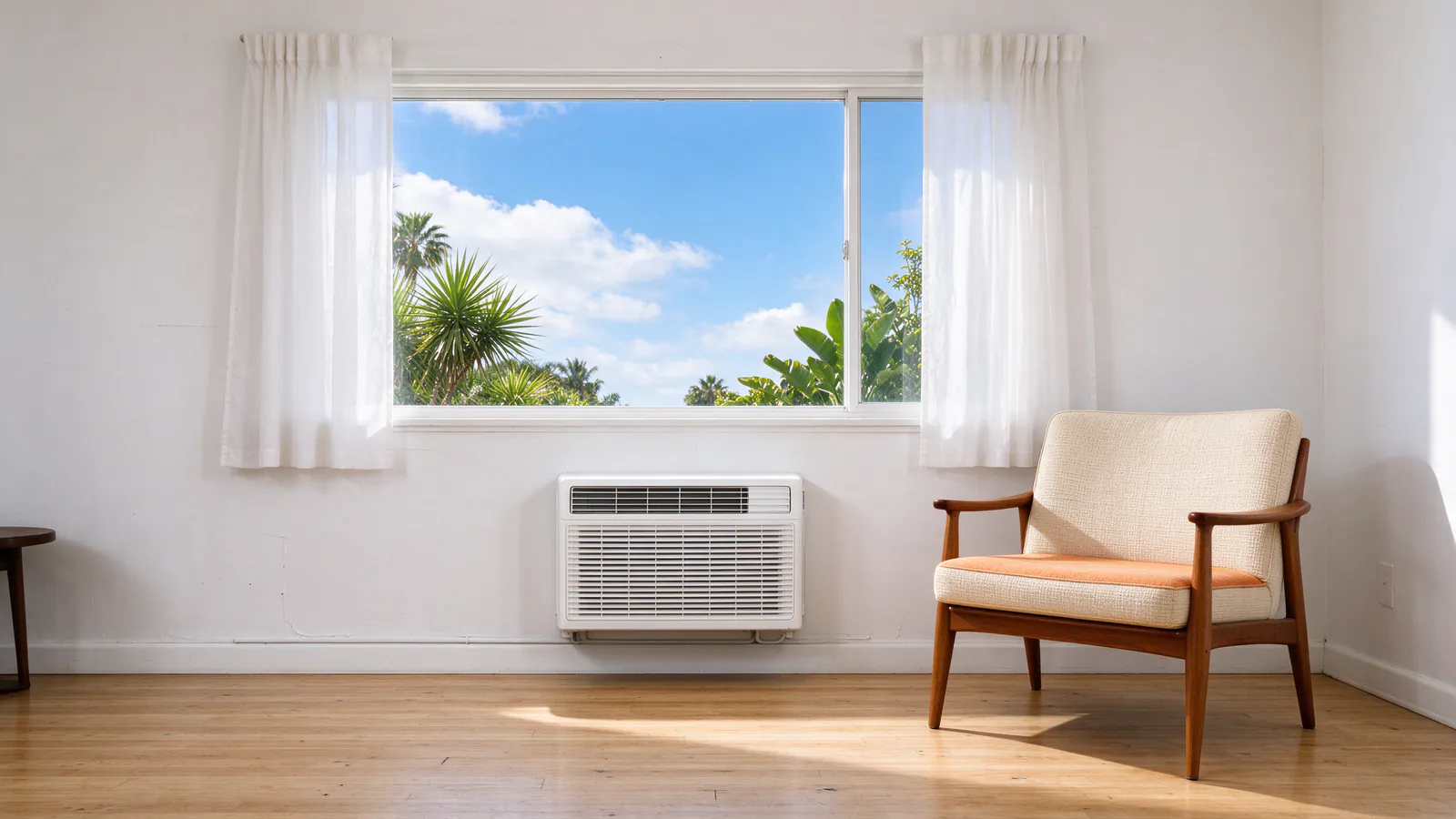
There are four types of mini split indoor unit: wall-mounted heads, ceiling cassettes, floor consoles and concealed duct units (also called ducted or slim duct air handlers). All of them connect to the same kind of outdoor unit. Wall heads are the simplest and least expensive; the others trade cost, condensate complexity and service access for appearance or air distribution.
Mesa Mini Split San Diego installs every one of these types across San Diego County, from a single wall head to ceiling cassettes and concealed duct systems, with the work done by licensed and insured contractors holding the California C-20 (HVAC) license. This guide compares them so you can see which fits a room before a site visit.
What every indoor unit is
Whatever it looks like, a mini split indoor unit is an air handler. Room air is drawn through a filter and across a refrigerant coil by a quiet blower, then blown back into the room. In cooling, the coil runs below the dew point, so water condenses on it and runs into a drain pan; in heating, the coil runs hot and stays dry. Each unit carries its own controls and talks to the outdoor unit through the communication cable that runs with the line set. The type changes where these parts sit and how the air leaves.
Wall-mounted heads
A wall head mounts on a bracket high on a wall and throws air horizontally across the room, with louvers that swing up and down and, on many models, side to side. It is the default for single-zone installations because it needs no framing work: one penetration through the wall behind it carries the line set, cable and drain.
On an exterior wall, the drain usually falls to the outside by gravity. Service access is easy; the filters lift out from the front and the cover comes off for coil and blower cleaning. The downside is visibility: a white box on the wall, which some owners of older or carefully finished houses do not want.
Ceiling cassettes
A cassette sits recessed in the ceiling with only a square grille showing. Most throw air in four directions, which suits large or square rooms, open-plan living areas and spaces where wall space is taken by windows or cabinets. Some models also come in one- or two-way versions for edges of rooms.
The cost is in the structure and the water. A cassette body fits between ceiling joists and hangs from threaded rods, so joist spacing, ducts, wiring and plumbing in the ceiling all matter; homeowners report having to add framing where the joists do not match the cassette’s frame. Most cassettes need a condensate pump, often built in, to lift water to a drain line. The ceiling above needs access for the line set and drain, which is easiest under an attic. Filters are reached from below by dropping the grille. Cassettes carry a price premium over wall heads for these reasons.
Floor consoles
A floor console sits low on the wall, a little like a radiator, and blows air up and out from the top and sometimes the bottom. It fits under windows, in attic rooms where a sloped ceiling leaves no high wall, and in rooms where a high wall head would look out of place. In heating, warm air leaves near the floor where people feel it. The drain often runs out through the low exterior wall by gravity, and service access is as easy as a wall head. Furniture in front of the console blocks its air, so the layout of the room matters.
Concealed duct units
A concealed duct unit is a compact air handler hidden in an attic, a dropped soffit or a closet, feeding short ducts to one large room or two or three neighboring rooms through ordinary grilles. No equipment shows in the room. This is the choice for owners who want a central-air look without full ductwork, and it is covered in depth on the concealed duct installation page.
The trades are real. Rooms served by one unit share one setpoint. Ducts in an unconditioned attic lose some heat and coolness through their walls, and duct design affects airflow and noise. In the City of San Diego, Information Bulletin 103 calls for a HERS evaluation where more than 40 feet of new ductwork is installed, so a long duct layout can add a field verification step. The unit needs a condensate path, usually a pump if it sits in an attic, and a reachable filter.
Indoor unit types compared
| Type | Air throw | Condensate | Service access | Looks | What pushes the cost |
|---|---|---|---|---|---|
| Wall-mounted head | Across the room from high on a wall | Gravity on an exterior wall; pump on interior walls | Easy: filters and cover from the front | Visible box on the wall | Interior-wall locations, long line-set routes |
| Ceiling cassette | Four ways (or one or two) from the ceiling | Usually a pump, often built in | Grille drops from below; attic access helps | Flush grille only | Framing, ceiling work, pump, attic access |
| Floor console | Up and out from low on the wall | Often gravity through a low wall | Easy from the front | Low, compact box | Fewer models; furniture layout |
| Concealed duct | Through ducts and grilles to one or more rooms | Usually a pump in an attic | Through an attic hatch or access panel | Grilles only | Ductwork, attic or soffit work, pump, verification |
No public price figure exists for each type’s premium; the installation cost guide and cost estimator give the San Diego ranges by number of heads.
How airflow decides comfort
A room’s comfort depends on where conditioned air reaches, not just on capacity. Air from a wall head travels a limited distance before it slows and mixes; a long, narrow room or an L-shaped one can leave its far end warm even when the head is sized correctly. A cassette in the middle of a square room spreads air more evenly. Closed doors stop air from reaching other rooms, which is why one head rarely conditions a whole floor and why a multi-zone system puts heads where rooms are used with doors closed. Not every room needs its own head either; a hallway or a rarely used room can borrow from a neighbor with the door open. The sizing guide covers how loads and room use set the head count.
Choosing and placing a head
Start with the room: its shape, which walls are free, whether there is attic space above, and where people sit and sleep. A wall head goes high, with a clear path across the room and out of the direct line of a bed or desk. A cassette goes near the center of the space it serves. A console goes where its air is not blocked. Every location also needs a drain route, which the condensate drainage guide explains, and the outdoor end of the line set has its own rules in the placement guide.
On a multi-zone system the head types can be mixed, within the combinations the manufacturer lists as compatible with the outdoor unit. A site visit checks the joists, the attic and the walls before a type is chosen; call or request an estimate to book one.