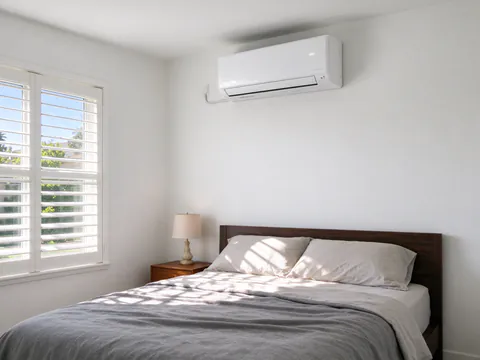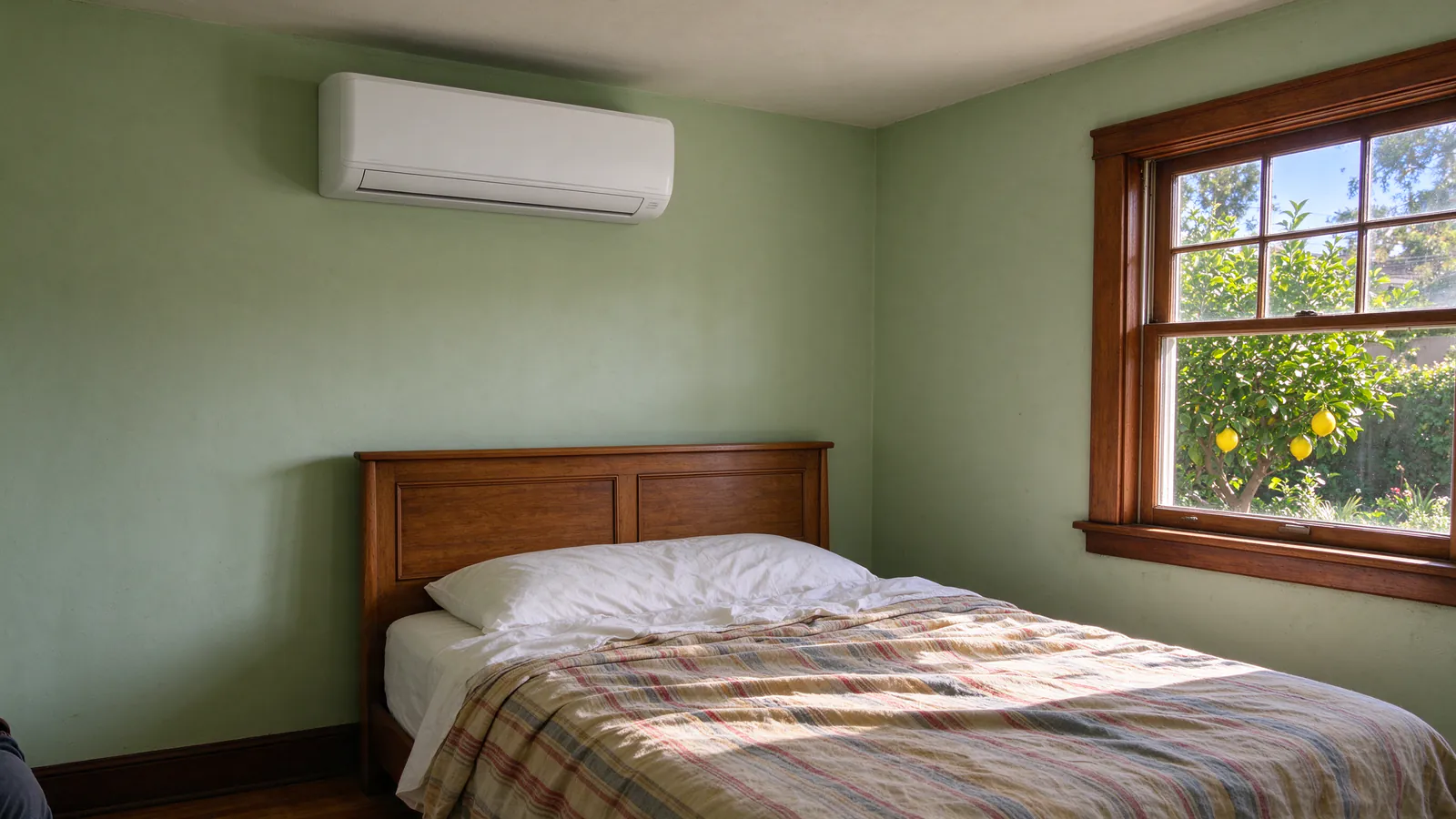
A window unit is the low-cost, no-permit choice for one room and a short horizon. A mini split costs more and needs a permit, but it runs much quieter, leaves the window free and lockable, usually heats as well as cools, and slows its output to match the room instead of cycling on and off. For a room you will cool for years, the mini split usually wins.
Mesa Mini Split San Diego installs single-room mini splits across San Diego County, with the work done by licensed and insured contractors holding the California C-20 (HVAC) license. Window units are not something it sells, and for some readers a window unit is the right answer; this guide says when.
How each one works
A window unit is a complete air conditioner in one box: compressor, both coils and both fans. It sits in the window opening with its hot side outdoors and its cold side indoors, plugs into an ordinary outlet and comes out again at the end of summer.
A mini split separates the parts. The compressor and outdoor coil sit outside on a pad or bracket; a slim indoor head mounts high on the wall; two insulated copper refrigerant lines, a control cable and a condensate drain pass through one small hole in the wall. It is installed, wired to its own circuit and stays put. The single-zone installation page covers what that work involves.
Portable units are a third option: a floor-standing box that vents through a hose to the window. They are the least efficient of the three, as the FAQ below explains.
Noise
The compressor is the loudest part of any air conditioner. In a window unit it sits in the window frame, a few feet from the bed or desk, and cycles on and off with a noticeable start. In a mini split it sits outside, and the only indoor noise is the head’s fan, which runs at a low speed most of the time. For a bedroom or a room where people work on calls, this is often the deciding difference. The outdoor unit still makes sound, and in the City of San Diego its location has to respect setbacks and the noise limits at the property line; the noise guide covers both sides.
Efficiency and running cost
Most window units run their compressor at one speed: fully on until the room is cool, then off. A mini split’s inverter compressor varies its speed, so on a mild coastal day it can run slowly and steadily, and on a hot inland afternoon it can run hard. Steady low-speed running is efficient, holds the temperature closer to the setpoint, and removes more moisture, which matters near the coast where August dew points average about 62.5°F.
A window unit also leaks. The gap between the unit, the sash and the frame is rarely sealed well, so cool air escapes and warm air comes in around it. A mini split’s only opening is a sealed penetration behind the head.
Electricity is expensive in San Diego. On SDG&E’s published rates, which change through the year, summer on-peak power from 4 to 9 p.m. costs about 69 cents per kWh on the standard TOU-DR1 rate and about 73 cents on TOU-ELEC. Running an inefficient unit through those hours is expensive. How much a mini split saves over a window unit depends on the models, the room and the hours it runs; no saving is guaranteed. The operating cost guide works through the rates.
The window, security and light
A window unit occupies the window. On a ground floor, a propped sash with a box in it is harder to secure than a closed, locked window, which is one more reason to take it out for winter. It blocks part of the view and the light, and in a bedroom it can obstruct the window people would use to get out in an emergency, which is worth thinking about before choosing which window to use. A mini split leaves every window free to open, close and lock.
Cooling only, or a heat pump
Window air conditioners are mostly cooling-only, though window heat pumps exist. Most mini splits are heat pumps: the same equipment reverses to heat in winter. That matters in San Diego, where many older houses are heated by electric wall or baseboard heaters. A heat pump delivers several units of heat for each unit of electricity, while resistance heat delivers one, so replacing resistance heat is where heating savings are most likely. Against gas heat the case is cooling and comfort, not a lower heating bill.
A heat pump also brings two practical differences:
- Rate eligibility. SDG&E’s TOU-ELEC rate is open to homes with an electric heat pump for climate control. A cooling-only unit does not qualify the home.
- Title 24 verification. For new installed systems, the California Energy Commission requires refrigerant charge verification on heat pumps in every climate zone, and on cooling-only air conditioners only in zones 2 and 8 through 15. A cooling-only mini split in coastal San Diego (zone 7) skips that step; inland in El Cajon or Escondido (zone 10) it does not. The permits guide explains the process.
Permits
The CEC’s guidance already excepts plug-in room appliances from the permit that other space-conditioning equipment needs. SB 222 makes that explicit statewide: from January 1, 2027, a city or county may not require a permit or inspection for a plug-in-ready window air conditioner or window heat pump when all of these are true:
- The appliance is rated at 120 volts or less
- It is a self-contained unit
- It does not need a dedicated circuit
- It does not need an electrical panel upgrade for its load
- It does not need drainage or structural modifications
A larger 240-volt window unit, or one that needs a new circuit or a modified opening, falls outside that exemption. A mini split always needs a permit; in the City of San Diego it is normally a no-plan combination permit starting at $176.57 for the first indoor unit, and the contractors pull it and coordinate the inspection as part of the work.
Owners, residents who rent, and condos
In a rented home, the choice usually depends on who owns the walls. A window unit is portable and goes with the occupants, subject to the lease. A mini split means a hole in an exterior wall, an outdoor unit, a new circuit and a permit, which is the property owner’s decision and investment. Where an owner is willing, a mini split in the hottest room is a lasting improvement to the property.
For owners in condos and HOAs, AB 1684 adds Civil Code section 4738 from January 1, 2027: an association cannot prohibit or restrict a member from installing a code-compliant cooling system, including a heat pump, in the member’s separate interest, with exceptions where the work would break the law or a required permit is not granted. The condo installation page covers where outdoor units and lines can go.
Households with limited income have another route. SDG&E’s Energy Savings Assistance program, for households at or below 250% of the federal poverty guidelines, lists room air conditioner replacement and portable air conditioners among its no-cost measures, though not mini splits. The rebates guide lists that and the other programs.
Cost
A single-zone mini split typically costs about $3,000 to $7,500 installed in the San Diego area, covering the equipment, line set, wall penetration, condensate drain, electrical hookup and commissioning for one room. A window unit costs far less to buy and needs no installer. The cost guide and the cost estimator give the mini split detail.
Which fits your situation
| Situation | Usually the better fit |
|---|---|
| Short stay, rented room, or a tight budget this summer | Window unit |
| Bedroom or office you will use for years | Mini split |
| Room heated today by an electric wall heater | Mini split (heat pump) |
| Ground-floor window you want to keep locked | Mini split |
| Room with no suitable window, such as a converted garage | Mini split; see garage installation |
| Several rooms need cooling | Mini split, single-zone or multi-zone |
Any mini split should still be sized to the room, not bought big for the sake of it; the sizing guide explains why. If the mini split route fits, a site visit settles the head position, outdoor spot, drain and circuit. Call or use the estimate form to book one.