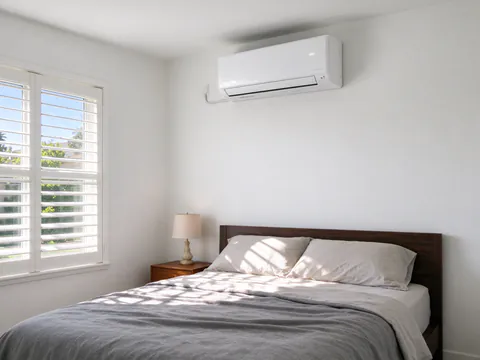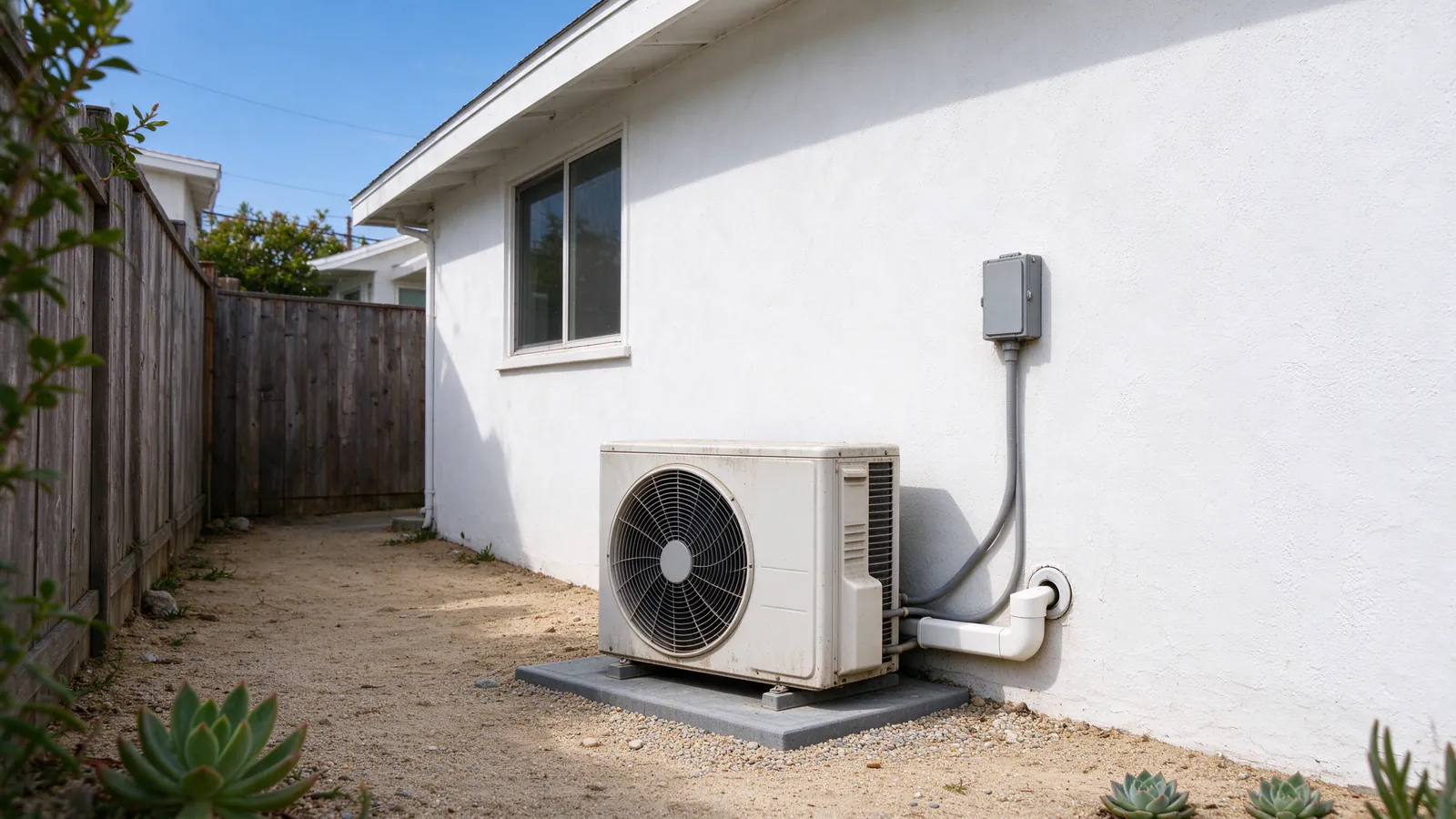
Near the ocean, choose for salt and moisture: a factory anticorrosion coating on the outdoor coil, a spot out of the direct onshore wind, and an inverter unit that can run long and slow to pull humidity out. Inland, choose for heat: El Cajon’s cooling design day is 90°F against 82°F at the coast, so capacity, sun exposure and heating output at colder nights matter more.
Mesa Mini Split San Diego installs ductless mini splits from Ocean Beach to El Cajon and Escondido, with the work done by licensed and insured contractors holding the California C-20 (HVAC) license. This guide compares the two climates with the official numbers and shows how each one changes the equipment, where it goes and how it is sized.
Two climates in one county
Most of the difference shows up in three numbers: the 1% cooling design temperature (the heat a system is sized for, exceeded only about 1% of the year), the heating design temperature, and how often it reaches 90°F.
| Location | Title 24 zone | 1% cooling design | Heating design | Days at 90°F or hotter |
|---|---|---|---|---|
| San Diego, Lindbergh Field | 7 | 82°F | about 42 to 44°F | about 3 |
| Oceanside | 7 | 78°F | about 37 to 39°F | about 5 |
| Chula Vista | 7 | 83°F | about 38 to 40°F | about 5 |
| Escondido | 10 | 88°F | about 31 to 34°F | about 54 |
| El Cajon | 10 | 90°F | about 34 to 36°F | about 57 |
| Ramona | 10 | 96°F | about 28 to 31°F | about 62 |
Design temperatures come from the CEC’s Joint Appendix JA2; days at 90°F or hotter from NOAA’s 1991 to 2020 climate normals; zones from point lookups on the CEC’s climate zone map, which is confirmed for each address because the City of San Diego and some ZIP codes straddle the line. The El Cajon, Escondido and coastal San Diego pages put each area’s numbers in local context.
On the coast: humidity is a large share of the load
Coastal summer air is mild but damp. NOAA’s hourly normals put Lindbergh’s mean dew point at 61°F in July, 62.5°F in August and 61.1°F in September, with early-morning relative humidity around 80% through the summer. The CEC’s design data shows why that matters: the mean coincident wet bulb at the 1% design condition is 69°F at both Lindbergh (82°F dry bulb) and El Cajon (90°F). The coast carries about the same moisture at a much lower temperature, so a larger share of the coastal cooling load is latent, meaning water to be condensed out of the air rather than heat to be removed.
An air conditioner removes moisture only while its indoor coil stays below the dew point long enough for water to collect and drain. That is why coastal equipment should be chosen for how low it can run, not how much it can deliver:
- Turndown. An inverter compressor that can slow to a small fraction of its rated output keeps running through a mild, muggy afternoon instead of cooling fast and stopping. Long, slow cycles are where dehumidification happens.
- Dry mode. Most mini splits have a dry setting that runs the coil cold at low fan speed. It is worth knowing how the chosen model handles it.
- Not oversizing. A unit that is too big for a coastal room satisfies the thermostat in minutes and leaves the air clammy. The sizing guide explains the mechanism.
Every head that dehumidifies makes water, so the condensate drain works hard in coastal summers too. NOAA publishes hourly humidity normals for no inland San Diego station, so there is no official inland comparison; inland heat is dominated by temperature.
On the coast: salt air and the outdoor coil
Onshore wind carries salt that settles on the thin aluminum fins of the outdoor coil. Salt holds moisture against the metal and speeds corrosion; corroded fins pass heat poorly, which reduces capacity and efficiency over time. The defenses are equipment and placement, not a distance rule:
- Placement. One major manufacturer’s installation manual tells installers to choose a location where the unit is not directly exposed to salt, because it may shorten the unit’s life. In practice that means the lee side of the house, out of direct onshore wind, where the City’s setback rules allow it. The placement guide covers those rules.
- Coil protection. Some product lines carry factory anticorrosion fin treatments. One manufacturer describes its coating as rated for 2,000 hours under the ASTM B117 salt-spray test. A coating slows corrosion; it does not make a coil immune, and no coating comes with a set number of added years.
- Exposure, not mileage. No manufacturer document sets a distance from the ocean at which coastal protection becomes necessary. The useful questions are whether the spot faces the water, takes spray, sits on a bayfront or catches the wind off the beach.
Homeowners report that coil coating was included by some bidders, priced as an extra by others, and added delivery time when it was applied by a third party. Ask each bidder to name the coil protection of the exact model quoted. Rinsing salt from the coil as the manufacturer directs belongs in coastal maintenance.
Inland: heat, sun and long cooling seasons
Inland valleys run a different season. NOAA’s normals put El Cajon at about 57 days a year at 90°F or hotter, Escondido about 54 and Ramona about 62, against about 3 at Lindbergh. During the September 2024 heat event, NOAA station records show El Cajon reaching 108°F and Escondido 112°F with an overnight low of 79°F.
Sun is the second inland factor. Clear inland afternoons put strong low-angle sun on west-facing walls and windows at the hottest hour, and every square foot of unshaded west glass adds heat that the room’s head has to remove. A bedroom with a big west window and an attic above can carry a much larger load than a north-facing room of the same size next door. That is why inland load calculations look closely at window orientation, shading and roof exposure, and why a head for a sunroom, a room addition or a converted garage is sized on its own numbers.
The outdoor unit works harder inland too. Outdoor units move heat into hotter air on a 90°F-plus afternoon, and their output and efficiency at those temperatures appear in the manufacturer’s extended performance data. Ask for capacity at the local design temperature, not just the nameplate rating.
Heating: low-temperature capacity, coast vs inland
Heat pump output falls as the outdoor temperature drops, because there is less heat in the outdoor air to move inside. What matters is whether a specific model’s published output at the local heating design temperature covers the room’s heating load.
- Coast. At a 42 to 44°F design temperature the heating load is small, and nearly any heat pump mini split covers it. A cold-climate model’s ability to deliver heat far below freezing is not a coastal need.
- Inland. El Cajon and Escondido design in the low to mid 30s, and NOAA’s normals record a few frost nights a year at El Cajon. Heating output at those temperatures is worth checking, and defrost cycles become part of normal winter operation.
- Ramona and the edges. Ramona designs at about 28 to 31°F and averages about 40 nights a year at or below freezing. Low-temperature output deserves real attention there; a model rated for colder conditions can make sense on that equipment’s merits.
- North County coast. Oceanside’s heating design temperature is several degrees colder than Lindbergh’s, with about 8 frost nights a year at its airport. Coastal does not mean identical.
Cold-climate claims are equipment specific. Use the manufacturer’s certified low-temperature data for the model in the quote, not a general promise that a mini split “works in any weather”.
Climate zone 7 vs zone 10 on paper
Title 24 treats the two zones differently in one way that touches mini splits: refrigerant charge verification. The CEC requires it for new heat pumps in every zone, but for cooling-only air conditioners only in zones 2 and 8 through 15. A cooling-only unit on the coast (zone 7) is not prescriptively verified; the same unit in El Cajon (zone 10) is. A heat pump mini split is verified in both. The permits guide covers the paperwork and the City’s fees.
What this means for sizing and equipment
The same room gets two different answers, and each climate punishes a different mistake. On the coast, oversizing is the common failure: a big unit short-cycles, misses the moisture and runs inefficiently through a mild season. Inland, undersizing shows up on the hottest afternoons, and a unit sized without regard to west sun or attic heat never reaches the setpoint.
| Decision | Coastal home (zone 7) | Inland home (zone 10) |
|---|---|---|
| Capacity | Sized tightly to a modest load; lowest output matters | Sized to an 88 to 96°F design day plus solar gain |
| Outdoor coil | Anticorrosion coating worth asking about where exposed | Standard coil; keep it clear of dust and leaves |
| Placement | Lee side, out of direct onshore wind | Shaded where airflow allows; clear of reflected heat |
| Heating | Small load; almost any heat pump covers it | Check output at 31 to 36°F, lower in Ramona |
| Upkeep | Rinse salt as the manufacturer directs; clean drains | Filters and coil cleaning after dusty, hot seasons |
None of that replaces a load calculation for the actual rooms. The single-zone installation page covers one-room systems, multi-zone installation covers several rooms, and the cost guide shows what each costs.
The next step is a site visit where the rooms are measured, the design conditions for the address are applied, and the outdoor unit’s spot is chosen for exposure and setbacks. Call or use the estimate form to book one.