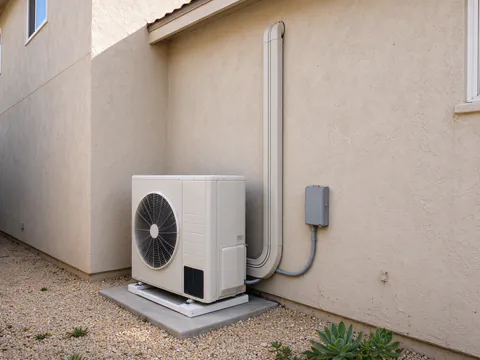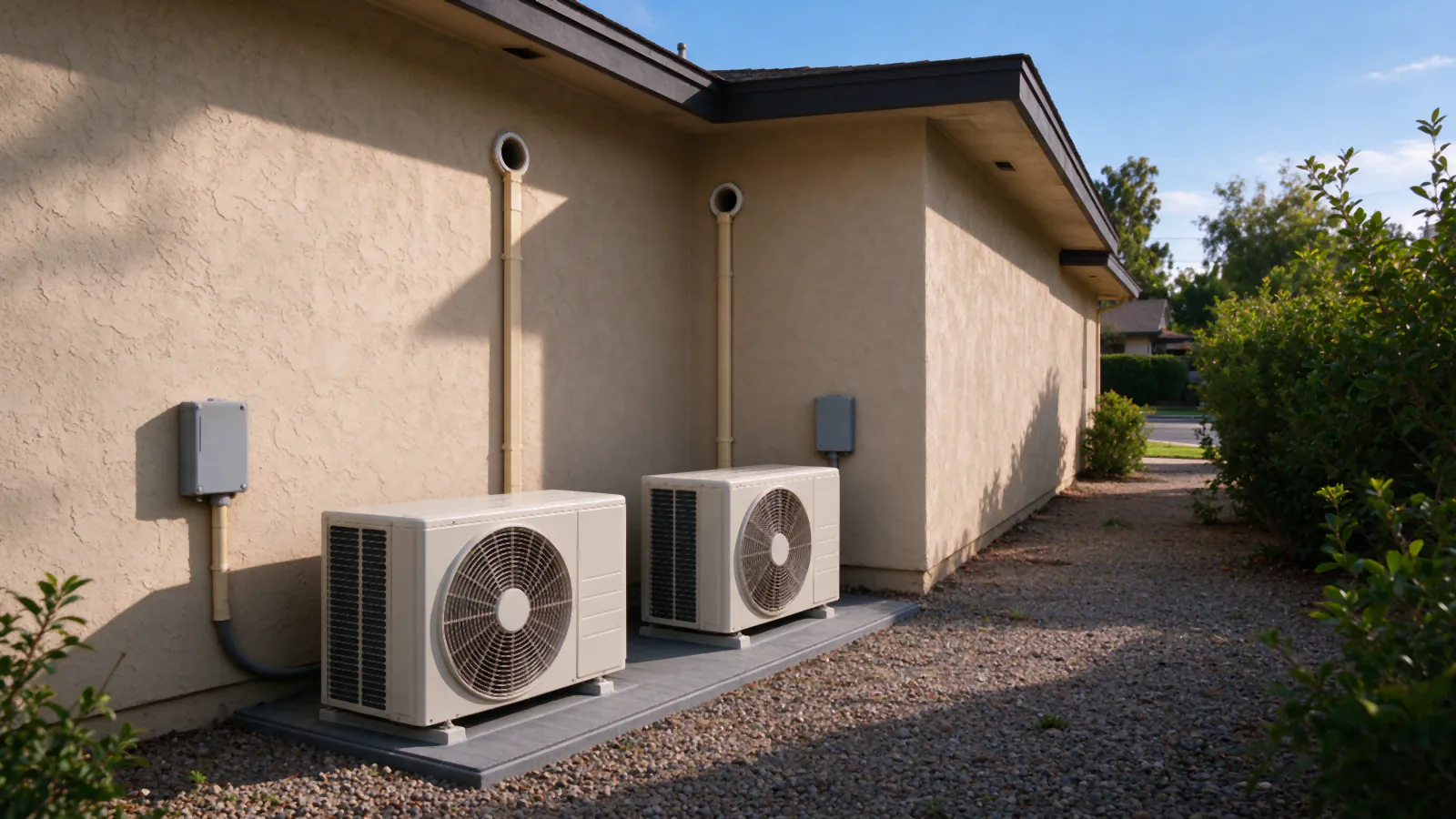
Choose separate single-zone mini split systems when rooms are used on different schedules, have very different loads, or must not all fail together. Choose multi-zone when several rooms need conditioning, outdoor space is tight, and the rooms’ combined loads fit one outdoor unit’s range. A multi-zone shares one compressor and usually costs less up front; single-zones cost more but keep each room independent.
Mesa Mini Split San Diego designs and installs both single-zone and multi-zone mini splits across San Diego County, with the work done by licensed and insured contractors holding the California C-20 (HVAC) license. This guide compares the two layouts on the points that decide the choice in a real house, using the San Diego price ranges for the cost side.
What actually differs in the hardware
A single-zone system pairs one outdoor unit with one indoor head. The compressor, its electronics and its refrigerant circuit serve that room alone, and the outdoor unit is sized for that room’s load.
A multi-zone system connects several indoor heads to one larger outdoor unit. Each head gets its own pair of refrigerant lines back to the outdoor unit, or the lines run to a branch box that distributes refrigerant to several heads. The outdoor unit modulates its compressor to serve whichever heads are calling.
The two can be mixed. A house might have a multi-zone system for three bedrooms and a separate single-zone for a garage office or an ADU out back. Neither layout changes what each room needs inside: every head has its own wall penetration and its own condensate drain, by gravity or pump, because every head that cools makes water.
The cost logic
The San Diego-area ranges, installed, are about $3,000 to $7,500 for a single-zone system and about $7,000 to $16,000 for two or three heads, with two-head systems toward the lower part of that range. Whole houses with four or more heads start around $13,000 and commonly pass $18,000.
The multi-zone saving comes from sharing. Two rooms on one outdoor unit share one compressor, one pad or bracket, one electrical circuit and disconnect, and one setup and commissioning visit. Two single-zones duplicate all of that.
Illustrative, not a quote: two separate single-zone systems, each somewhere in the single-zone range, add up to roughly $6,000 to $15,000. A two-head multi-zone system sits toward the lower part of the $7,000 to $16,000 range. The ranges overlap, which is the honest point: the gap depends on the line-set routes, the head styles, the panel and how far apart the rooms are. Two rooms on opposite sides of a house can need long line sets back to a shared outdoor unit, which narrows the saving; two adjacent rooms share most of the route.
Permits follow the same pattern. In the City of San Diego the mini split permit is $176.57 for the first indoor unit and $52.39 for each added one, and the number of indoor heads is the same either way. If the City also charges its $131.52 condensing-unit item, two outdoor units would carry it twice; the exact total is set when the permit is issued. The cost guide and the cost estimator carry the full picture.
Efficiency at part load and minimum output
Efficiency on paper and efficiency in a San Diego bedroom are different things, because most hours are part-load hours. An inverter outdoor unit can slow its compressor to a minimum output, but not below it. A multi-zone unit sized for three or four rooms has a higher minimum than a small single-zone unit sized for one.
Consider a summer night when only the primary bedroom is occupied. On a multi-zone system the large outdoor unit serves one small head. If its minimum output is more than that room needs, it has to cycle off and on, which loses the steady, moisture-removing operation that makes an inverter comfortable, especially in humid coastal weather. A single-zone unit sized for that room can simply run slowly all night.
Ratings reflect this. SEER2 measures seasonal cooling efficiency and HSPF2 seasonal heating efficiency under standardized test conditions, and small single-zone systems often carry higher ratings than larger multi-zone outdoor units. Homeowners comparing quotes report the same thing: two small single-zone systems listed at noticeably higher SEER than one two-zone unit. A rating is a test result, not a bill; how the rooms are used decides which layout runs more efficiently in a given house. The operating cost guide shows how SDG&E’s time-of-use prices enter the comparison.
The design check for a multi-zone system is therefore more than adding up nominal head sizes. Each room’s load, the outdoor unit’s minimum output, the likely pattern of rooms calling together and the smallest room’s load all matter. The sizing guide covers the load calculation that feeds this.
Uneven temperatures and mode conflicts
Uneven room temperatures have two common causes in ductless layouts. The first is asking one head to serve rooms it cannot reach: a hallway head expected to cool bedrooms with closed doors, or a living room head expected to carry a kitchen around a corner. That is a zoning problem, solved by the layout, whichever outdoor arrangement is used.
The second is specific to multi-zone systems. Most residential multi-zone outdoor units run every head in the same mode. In inland spring and fall, a west room in afternoon sun can want cooling while a shaded north room wants heat. On a shared outdoor unit one of them waits; with separate single-zones each room gets what it needs. On the coast the conflict is rarer, but it is worth asking how the chosen model handles it.
Redundancy
A multi-zone system has one compressor. If it fails, or its control board or refrigerant circuit does, every connected room loses heating and cooling until it is repaired. Separate single-zones fail one at a time. For a household with someone heat-sensitive, a home office that cannot close, or a server closet, that difference can outweigh the up-front cost; the emergency repair page covers what happens when a system goes down in a heat wave.
Outdoor space and placement
Outdoor units need a level pad or bracket, clearance for airflow and service, and a legal location. In the City of San Diego, equipment in a required side or rear yard must sit at least 4 feet from the property line unless sound attenuation shows it meets the City’s noise limits, which drop to 40 decibels at night at a single-family property line. On a narrow lot in North Park or Ocean Beach, finding one compliant spot can be hard and finding three can be impossible, which pushes the design toward one multi-zone unit. The placement guide covers the rules.
Electrical and controls
Each outdoor unit needs its own dedicated 240-volt circuit and a disconnect. A multi-zone layout uses one circuit; three single-zones use three, which matters in an older panel with few open spaces. The electrical requirements guide explains the panel check.
Controls are similar in both: every head has its own setpoint and remote, and most can take a wall controller. The practical difference is the shared mode on a multi-zone system, and the fact that a single-zone’s controls never compete with another room’s.
Which layout fits which situation
| Situation | Usually fits better | Why |
|---|---|---|
| One room: bedroom, office, addition | Single-zone | Sized exactly to the room, lowest cost |
| Two or three adjacent rooms, tight side yard | Multi-zone | One outdoor unit, one circuit, shared route |
| Rooms used on very different schedules | Single-zones | Each unit runs near its own load |
| A small bedroom on a large shared system | Single-zone for that room, or a carefully matched multi-zone | Avoids short cycling at night |
| Rooms on opposite sides of the house | Often single-zones | Long line sets erode the shared saving |
| Whole house, four or more rooms | Multi-zone, several systems or a mix | Balanced by load, space and redundancy |
| A detached ADU or garage plus the house | Separate systems | Different loads, routes and permits |
When the layout is the open question, a site visit with room measurements and a load calculation produces a written scope for each option. Call or use the estimate form to book one.